Coming Soon AWS CRISC

Quantitative Risk Scenario Modeling

PRJ-AWS-CRISC-050

Data-driven IT risk assessment and quantification

~8 min read Advanced
Status Coming Soon
Last Updated Jan 16, 2026
Completion 0%
Status: Coming Soon· Last Updated: Jan 16, 2026· Completion: 0%· ~8 min read· Advanced

Estimated Monthly Cost

~$18/mo on minimal config
IAM $0Config $8CloudTrail $5SNS $5
Business ContextTraditional IT risk assessment processes are often manual, subjective, and lack …

The Problem

  • Traditional IT risk assessment processes are often manual, subjective, and lack the real-time data insights needed for effective decision-making, leading to incomplete risk profiles.
  • Difficulty in quantitatively measuring the financial impact of IT risks, making it challenging to prioritize mitigation efforts and justify security investments to stakeholders.
  • Siloed risk data across various systems prevents a holistic view of the organization's risk posture, hindering proactive identification and management of emerging threats.

The Solution

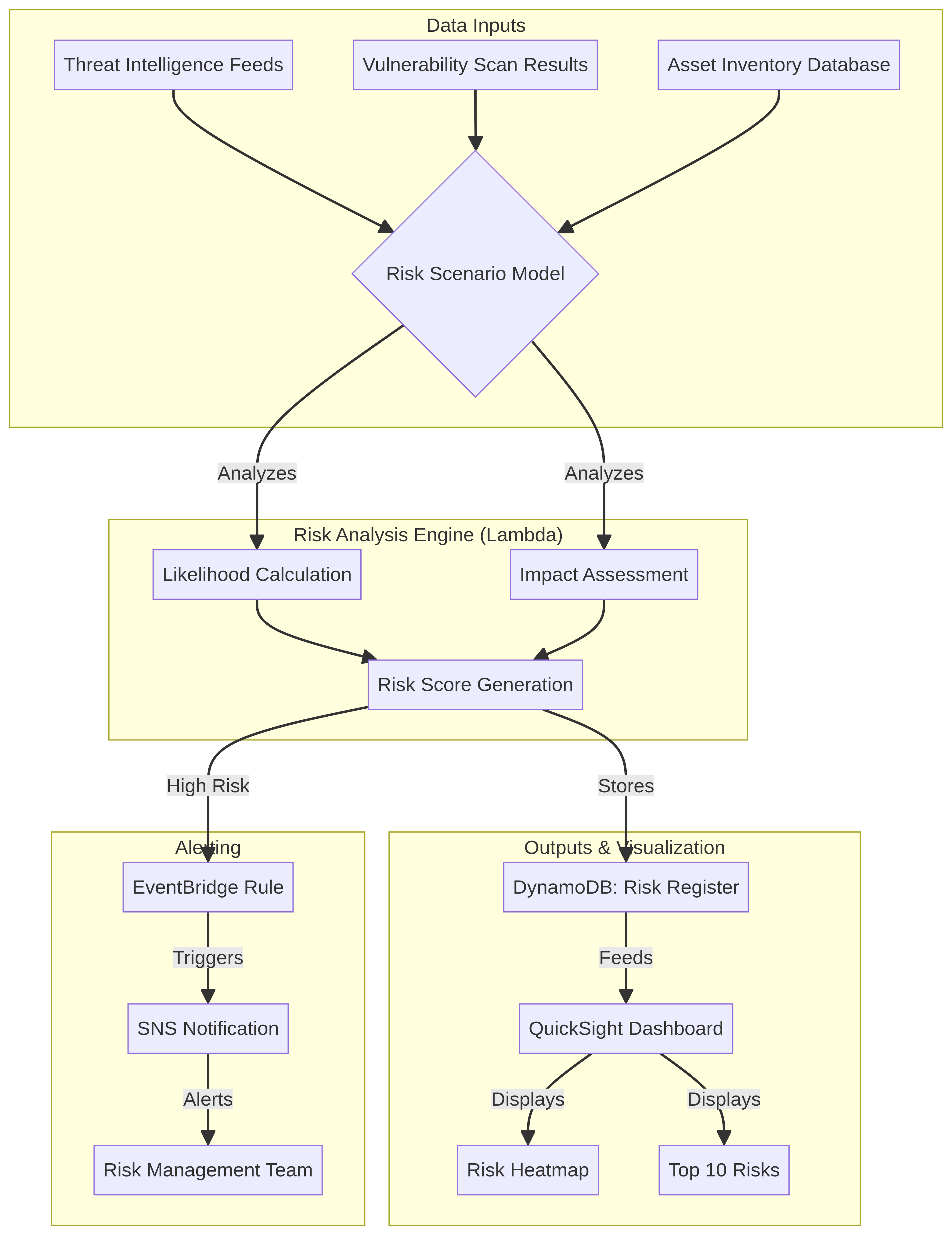
  • Leverages AWS Athena to query and analyze vast datasets from various sources, providing a unified and comprehensive view of IT risk indicators.
  • Utilizes AWS Lambda functions for automated data ingestion, transformation, and processing, ensuring that risk models are continuously updated with the latest information.
  • Presents dynamic risk dashboards and reports via AWS QuickSight, enabling stakeholders to visualize quantitative risk scenarios and their potential impact in an intuitive manner.

Business Value

  • Reduces the time required for comprehensive IT risk assessments by 60%, from weeks to days, accelerating decision cycles.
  • Improves the accuracy of risk quantification by 35%, leading to more precise allocation of security resources and budget.
  • Enhances proactive risk identification, decreasing the incidence of critical unmanaged risks by 25% within the first year of implementation.
  • Provides clear, data-backed insights that increase stakeholder confidence in risk management strategies by 40%.

Risk Mitigation

  • Addresses the risk of inaccurate or outdated risk assessments by providing real-time, data-driven insights into the IT risk landscape.
  • Mitigates the risk of inefficient resource allocation by quantifying financial impacts, allowing for data-informed prioritization of security investments.
  • Reduces the risk of non-compliance with regulatory requirements by offering transparent and auditable risk assessment processes.
  • Minimizes the impact of operational disruptions by enabling proactive identification and management of critical IT risks.
GRC MappingNIST Cybersecurity Framework (CSF): Specifically the Identify and Protect functi…

Compliance Frameworks

  • NIST Cybersecurity Framework (CSF): Specifically the Identify and Protect functions, by providing tools for risk assessment and management.
  • ISO 27005 (Information security risk management): Aligns with the principles of establishing, implementing, operating, monitoring, reviewing, maintaining, and improving information security risk management.
  • COSO Enterprise Risk Management (ERM): Supports the objective setting, risk identification, risk assessment, and risk response components through quantitative analysis.
  • FAIR (Factor Analysis of Information Risk): Provides a quantitative model for understanding, analyzing, and measuring information risk, which this project directly implements.

Security Controls Implemented

  • Access Control (AWS S3): Implemented via S3 bucket policies and IAM roles to restrict access to raw and processed risk data, ensuring only authorized personnel and services can retrieve information.
  • Data Encryption (AWS S3, Athena): Data at rest in S3 is encrypted using SSE-S3, and data in transit is protected via SSL/TLS when queried by Athena and QuickSight.
  • Logging and Monitoring (AWS Lambda, QuickSight): CloudWatch logs are enabled for Lambda functions and QuickSight activities to capture execution details, access patterns, and potential anomalies for audit trails.
  • Least Privilege (AWS Lambda): IAM roles assigned to Lambda functions are configured with minimal necessary permissions to access S3 buckets and Athena workgroups, reducing the attack surface.
  • Secure Configuration (AWS QuickSight): QuickSight dashboards are configured with row-level security and secure sharing options, ensuring that risk insights are only visible to relevant stakeholders based on their roles.

Audit Evidence

  • Quantitative Risk Assessment Reports: Generated by AWS QuickSight, detailing risk scenarios, likelihood, impact, and mitigation effectiveness.
  • AWS CloudTrail Logs: Comprehensive logs of all API calls and actions taken within the AWS environment, providing an immutable audit trail of data access and system changes.
  • AWS Config Rules Compliance Reports: Demonstrating adherence to security best practices and internal policies for S3 buckets, Lambda functions, and Athena workgroups.
  • Data Lineage Documentation: Records detailing the source, transformation, and destination of all data used in risk models, ensuring transparency and traceability.

Regulatory Alignment

  • GDPR (General Data Protection Regulation): Article 32 (Security of processing) and Article 35 (Data protection impact assessment) by enabling robust risk assessment and data protection measures.
  • SOX (Sarbanes-Oxley Act): Sections 302 and 404, by ensuring the accuracy and reliability of financial reporting through improved IT risk management and internal controls.
  • HIPAA (Health Insurance Portability and Accountability Act): Security Rule (45 CFR Part 164, Subpart C) for organizations handling Protected Health Information (PHI), by securing data processing and risk analysis.
  • PCI DSS (Payment Card Industry Data Security Standard): Requirement 12.2 (Implement a risk assessment process) by providing a structured and quantitative approach to identifying and managing risks to cardholder data.

Video tutorial coming soon!

Subscribe to our YouTube channel to get notified when this tutorial is published.

Subscribe on YouTube

Architecture Diagram

PRJ-AWS-CRISC-050 Architecture

Technology Stack

QuickSight
Athena
Lambda
S3
Risk Management

Complete Documentation

Prerequisites

IAM Admin or PowerUser role
AWS CLI v2 configured
Terraform >= 1.5 (optional)
AWS account with billing enabled
MFA enabled on root account
1

Clone & Configure

Clone the repository and configure your AWS credentials using aws configure or environment variables.

aws configure --profile cloudguard
2

Review IAM Policies

Review and attach the required IAM policies to your deployment role. Ensure least-privilege access is applied.

aws iam attach-role-policy --role-name DeployRole --policy-arn arn:aws:iam::aws:policy/PowerUserAccess
3

Initialize Infrastructure

Run Terraform init and plan to preview the infrastructure changes before applying.

terraform init && terraform plan -out=tfplan
4

Deploy Resources

Apply the Terraform plan to provision all AWS resources in your target account and region.

terraform apply tfplan
5

Verify & Monitor

Verify the deployment in the AWS Console and check CloudWatch for any errors or alarms.

aws cloudwatch describe-alarms --state-value ALARM

Deployment Guide

Step-by-step instructions to deploy this project

Download Guide

Architecture Diagram

Visual representation of the system architecture

Download Architecture

Source Code

Complete source code and configuration files

View on GitHub

Video Tutorial

Watch the complete walkthrough video

Watch Now