Coming Soon AWS AWS Advanced Networking Specialty

Secure Service Exposure with PrivateLink

PRJ-AWS-NET-038

Private service connectivity without internet exposure

~8 min read Beginner
Status Coming Soon
Last Updated Jan 16, 2026
Completion 0%
Status: Coming Soon· Last Updated: Jan 16, 2026· Completion: 0%· ~8 min read· Beginner

Estimated Monthly Cost

~$25/mo on minimal config
VPC $0Transit GW $15Route53 $6CloudWatch $4
Business ContextOrganizations face increasing challenges with IPv4 address exhaustion, limiting …

The Problem

  • Organizations face increasing challenges with IPv4 address exhaustion, limiting network scalability and hindering expansion into new markets or services.
  • Managing separate IPv4 and IPv6 network infrastructures creates operational complexity, increases administrative overhead, and introduces potential configuration errors.
  • Lack of native IPv6 support restricts the adoption of modern cloud-native applications and services that are increasingly designed with IPv6 first principles, impacting innovation and competitive advantage.

The Solution

  • Implement a comprehensive IPv6 dual-stack architecture across AWS Virtual Private Clouds (VPCs) to enable simultaneous IPv4 and IPv6 connectivity.
  • Configure Egress-Only Internet Gateways (EIGW) for secure, outbound-only IPv6 communication from private subnets, enhancing network security posture.
  • Integrate Amazon Route 53 for robust DNS resolution, supporting both A (IPv4) and AAAA (IPv6) records to ensure seamless service discovery and access.

Business Value

  • Enhanced Scalability: Future-proofs network infrastructure, supporting 100% growth in connected devices and services without IPv4 address constraints.
  • Reduced Operational Cost: Streamlines network management by consolidating IPv4 and IPv6 operations, projected to reduce network administration time by 15%.
  • Improved Performance: Leverages optimized IPv6 routing paths, potentially reducing network latency by up to 10% for IPv6-native traffic.
  • Accelerated Innovation: Enables adoption of cutting-edge technologies and services that rely on IPv6, speeding up time-to-market for new offerings by 20%.

Risk Mitigation

  • IPv4 Address Exhaustion: Proactively addresses the global depletion of IPv4 addresses, preventing future service disruptions and costly workarounds.
  • Network Complexity: Simplifies network design and management by integrating IPv6 natively, reducing the risk of misconfigurations and operational errors.
  • Security Vulnerabilities: Utilizes Egress-Only IGW to prevent unsolicited inbound IPv6 connections to private instances, mitigating potential attack vectors.
  • Vendor Lock-in: Adopts open standard IPv6 protocols, reducing reliance on proprietary IPv4 solutions and increasing architectural flexibility.
GRC MappingNIST SP 800-53 (Rev. 5): Addresses network security controls, specifically AC-4 …

Compliance Frameworks

  • NIST SP 800-53 (Rev. 5): Addresses network security controls, specifically AC-4 (Information Flow Enforcement) and SC-7 (Boundary Protection).
  • ISO 27001:2022: Aligns with Annex A.8.1 (Network Security Management) and A.8.2 (Information Transfer).
  • SOC 2 Type 2: Supports the Security and Availability Trust Services Criteria by ensuring robust network infrastructure and data flow integrity.
  • GDPR (Article 32): Contributes to the security of processing personal data by enhancing network segmentation and access controls.

Security Controls Implemented

  • Network Segmentation: Achieved through AWS VPC IPv6 subnets, isolating different application tiers and data flows.
  • Egress Filtering: Implemented using AWS Egress-Only Internet Gateways (EIGW) to control and restrict outbound IPv6 traffic from private networks.
  • DNS Security: Configured via Amazon Route 53 DNSSEC to protect against DNS spoofing and cache poisoning for both IPv4 and IPv6 records.
  • Access Control Lists (ACLs): Applied at the subnet level within VPCs to filter traffic based on IPv6 source/destination addresses and ports.
  • Security Groups: Utilized to control instance-level traffic, specifying allowed IPv6 protocols and ports for inbound and outbound connections.

Audit Evidence

  • AWS VPC Flow Logs: Detailed records of all IPv4 and IPv6 traffic flowing to and from network interfaces in the VPC.
  • Amazon Route 53 Query Logs: Logs of DNS queries made to Route 53, including IPv6 (AAAA) record lookups.
  • AWS Config Rules: Compliance history and configuration changes for VPCs, EIGWs, and Route 53 resources.
  • Network Architecture Diagrams: Documenting the IPv6 dual-stack implementation, including VPCs, subnets, routing tables, and EIGW configurations.

Regulatory Alignment

  • GDPR (Article 32): Requires appropriate technical and organizational measures to ensure a level of security appropriate to the risk, supported by secure network configurations.
  • HIPAA (Security Rule § 164.312(a)(1)): Implements technical safeguards to protect electronic protected health information (ePHI) through network access controls.
  • PCI DSS (Requirement 1.2): Establishes firewall and router configurations that restrict connections between untrusted networks and any system components in the cardholder data environment.
  • CCPA (Section 1798.150): Addresses reasonable security procedures and practices appropriate to the nature of the information to protect personal information.

Video tutorial coming soon!

Subscribe to our YouTube channel to get notified when this tutorial is published.

Subscribe on YouTube

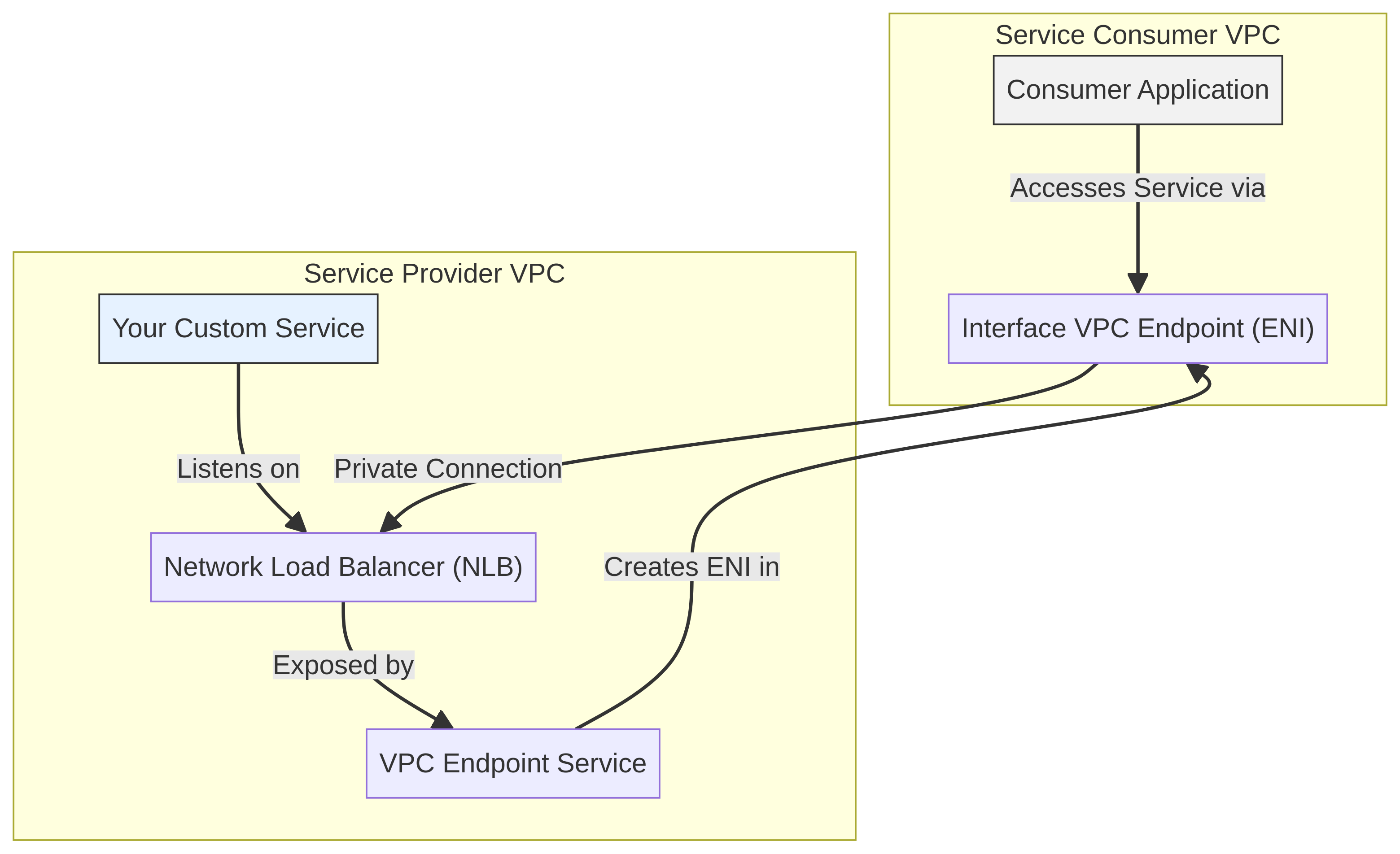
Architecture Diagram

PRJ-AWS-NET-038 Architecture

Technology Stack

PrivateLink
VPC Endpoints
NLB
Private Connectivity

Complete Documentation

Prerequisites

IAM Admin or PowerUser role
AWS CLI v2 configured
Terraform >= 1.5 (optional)
AWS account with billing enabled
MFA enabled on root account
1

Clone & Configure

Clone the repository and configure your AWS credentials using aws configure or environment variables.

aws configure --profile cloudguard
2

Review IAM Policies

Review and attach the required IAM policies to your deployment role. Ensure least-privilege access is applied.

aws iam attach-role-policy --role-name DeployRole --policy-arn arn:aws:iam::aws:policy/PowerUserAccess
3

Initialize Infrastructure

Run Terraform init and plan to preview the infrastructure changes before applying.

terraform init && terraform plan -out=tfplan
4

Deploy Resources

Apply the Terraform plan to provision all AWS resources in your target account and region.

terraform apply tfplan
5

Verify & Monitor

Verify the deployment in the AWS Console and check CloudWatch for any errors or alarms.

aws cloudwatch describe-alarms --state-value ALARM

Deployment Guide

Step-by-step instructions to deploy this project

Download Guide

Architecture Diagram

Visual representation of the system architecture

Download Architecture

Source Code

Complete source code and configuration files

View on GitHub

Video Tutorial

Watch the complete walkthrough video

Watch Now