Complete AWS AWS Security Specialty

Advanced Threat Detection with GuardDuty

PRJ-AWS-SEC-008

Automated threat detection and response system with SOC automation

~8 min read Advanced
Status Complete
Last Updated Mar 13, 2026
Completion 100%
Status: Complete· Last Updated: Mar 13, 2026· Completion: 100%· ~8 min read· Advanced

Estimated Monthly Cost

~$28/mo on minimal config
GuardDuty $12Security Hub $8Config $5CloudTrail $3
Business ContextOrganizations struggle with the sheer volume of security alerts, leading to aler…

The Problem

  • Organizations struggle with the sheer volume of security alerts, leading to alert fatigue and missed critical threats.
  • Manual correlation of security findings across disparate AWS services is time-consuming and prone to human error, delaying incident response.
  • Lack of real-time, automated response mechanisms allows threats to persist longer, increasing potential damage and data exfiltration risks.

The Solution

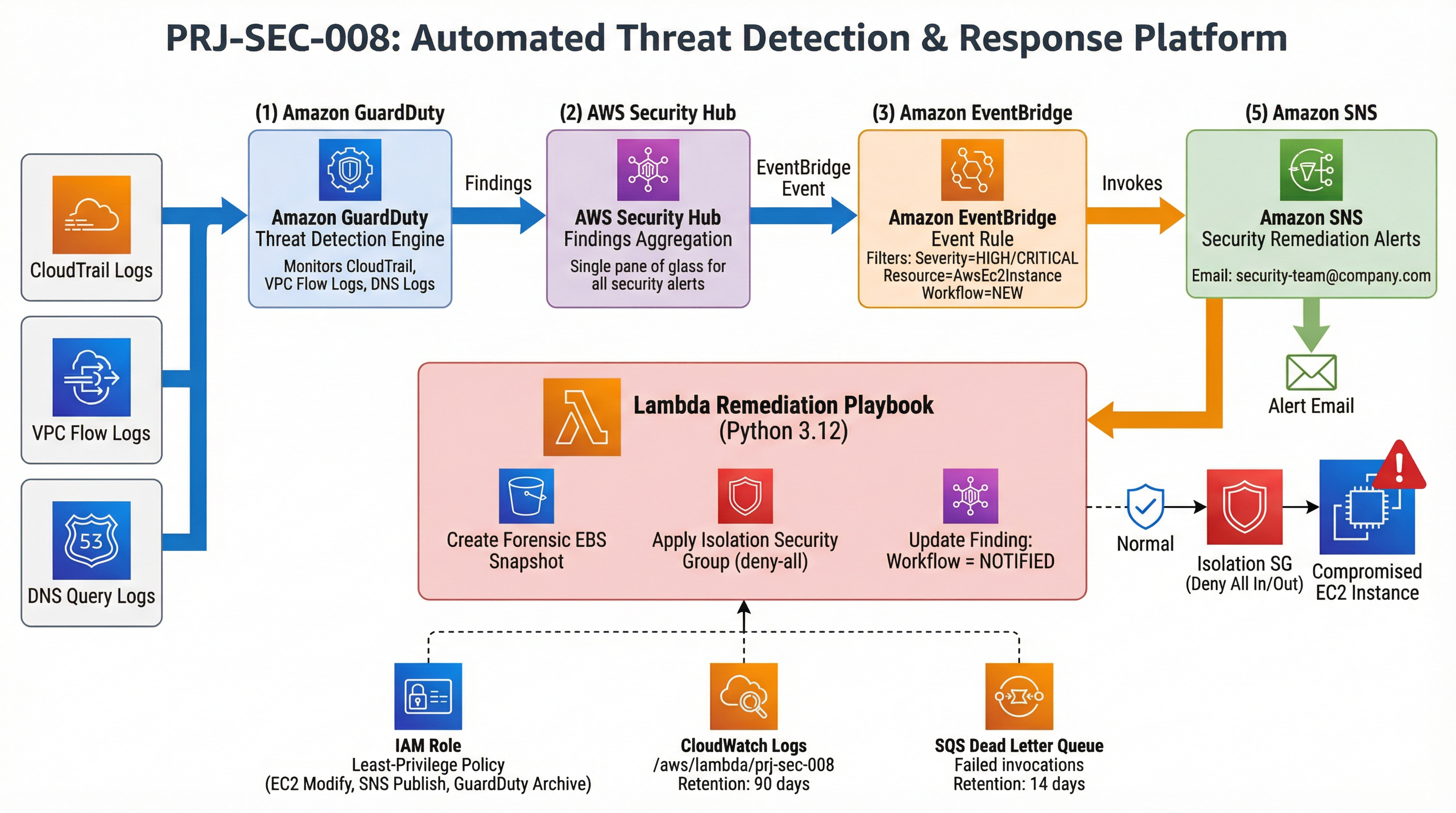
  • Leveraging AWS GuardDuty for continuous, intelligent threat detection across AWS accounts and workloads, identifying unusual and potentially unauthorized activity.
  • Aggregating and prioritizing security findings from GuardDuty and other AWS security services into a centralized view using AWS Security Hub.
  • Implementing automated remediation workflows using AWS Lambda functions triggered by Amazon EventBridge rules based on specific Security Hub findings, enabling rapid response.

Business Value

  • Reduces Mean Time To Detect (MTTD) security threats by 70%, from hours to minutes, through ML-powered detection.
  • Decreases manual security investigation effort by 60%, allowing security teams to focus on higher-value strategic initiatives.
  • Improves overall security posture score by 25% within the first six months by proactively addressing vulnerabilities and threats.
  • Prevents an estimated 15-20 critical security incidents annually through automated threat response and early detection.

Risk Mitigation

  • Mitigates the risk of undetected advanced persistent threats (APTs) and sophisticated malware by using behavioral anomaly detection.
  • Reduces the impact of insider threats and compromised credentials through continuous monitoring of user and role activity.
  • Prevents unauthorized data access and exfiltration by rapidly isolating compromised resources and blocking malicious activity.
  • Addresses potential compliance violations by ensuring a robust and auditable security detection and response mechanism.
GRC MappingISO 27001:2022(A.5.16 - Monitoring, reviewing and changing control processes)…

Compliance Frameworks

  • ISO 27001:2022 (A.5.16 - Monitoring, reviewing and changing control processes)
  • NIST Cybersecurity Framework (CSF) (Detect: DE.CM-4 - Monitoring for unauthorized activity)
  • SOC 2 Type II (Common Criteria 7.1 - Logical and Physical Access Controls)
  • PCI DSS v4.0 (Requirement 10.4 - Reviewing logs and security events)

Security Controls Implemented

  • Automated Threat Detection: AWS GuardDuty continuously monitors for malicious activity and unauthorized behavior.
  • Centralized Security Posture Management: AWS Security Hub aggregates and prioritizes security findings from GuardDuty and other services.
  • Incident Response Automation: AWS Lambda functions are triggered by EventBridge to automatically remediate identified threats.
  • Real-time Event-Driven Security Workflows: Amazon EventBridge routes security events to appropriate Lambda functions for processing.
  • Continuous Monitoring: GuardDuty provides ongoing monitoring of AWS accounts and workloads for suspicious activity.

Audit Evidence

  • AWS GuardDuty findings reports detailing detected threats and their severity.
  • AWS Security Hub consolidated findings dashboard and detailed reports.
  • AWS Lambda execution logs for automated remediation actions, including input and output.
  • Amazon EventBridge rule invocation logs demonstrating automated trigger events.

Regulatory Alignment

  • GDPR (Article 32 - Security of processing): Ensures appropriate technical and organizational measures for data security.
  • HIPAA (Security Rule § 164.308(a)(1)(ii)(D) - Information System Activity Review): Requires review of audit logs.
  • CCPA (Section 1798.150 - Data Security): Provides reasonable security procedures and practices.
  • NYDFS Cybersecurity Regulation (23 NYCRR 500.05): Requires monitoring and filtering of activity to detect unauthorized access.

Video tutorial coming soon!

Subscribe to our YouTube channel to get notified when this tutorial is published.

Subscribe on YouTube

Architecture Diagram

PRJ-AWS-SEC-008 Architecture

Technology Stack

GuardDuty
Security Hub
EventBridge
Lambda
SIEM

Complete Documentation

Prerequisites

IAM Admin or PowerUser role
AWS CLI v2 configured
Terraform >= 1.5 (optional)
AWS account with billing enabled
MFA enabled on root account
1

Clone & Configure

Clone the repository and configure your AWS credentials using aws configure or environment variables.

aws configure --profile cloudguard
2

Review IAM Policies

Review and attach the required IAM policies to your deployment role. Ensure least-privilege access is applied.

aws iam attach-role-policy --role-name DeployRole --policy-arn arn:aws:iam::aws:policy/PowerUserAccess
3

Initialize Infrastructure

Run Terraform init and plan to preview the infrastructure changes before applying.

terraform init && terraform plan -out=tfplan
4

Deploy Resources

Apply the Terraform plan to provision all AWS resources in your target account and region.

terraform apply tfplan
5

Verify & Monitor

Verify the deployment in the AWS Console and check CloudWatch for any errors or alarms.

aws cloudwatch describe-alarms --state-value ALARM

Deployment Guide

Step-by-step instructions to deploy this project

Download Guide

Architecture Diagram

Visual representation of the system architecture

Download Architecture

Source Code

Complete source code and configuration files

View on GitHub

Video Tutorial

Watch the complete walkthrough video

Watch Now
