Coming Soon AZURE Azure AI Engineer

Azure OpenAI Enterprise RAG Solution

PRJ-AZURE-AI-051

Enterprise-grade RAG with Azure OpenAI and Cognitive Search

~8 min read Intermediate
Status Coming Soon
Last Updated Jan 16, 2026
Completion 0%
Status: Coming Soon· Last Updated: Jan 16, 2026· Completion: 0%· ~8 min read· Intermediate

Implementation Guide

Comprehensive step-by-step deployment guide

Download Implementation Guide

Estimated Monthly Cost

~$38/mo on minimal config
ComputeStorageMonitor
Business ContextEnterprises struggle with extracting accurate and contextually relevant informat…

The Problem

  • Enterprises struggle with extracting accurate and contextually relevant information from vast, disparate internal data sources, leading to inefficient decision-making and missed opportunities.
  • Traditional search methods often yield generic results, failing to provide precise answers or synthesize information from unstructured data, hindering knowledge workers' productivity.
  • The risk of Large Language Models (LLMs) generating inaccurate or hallucinated responses is a significant concern, especially when deployed in critical business applications requiring high factual accuracy and trustworthiness.

The Solution

  • Implements an enterprise-grade Retrieval Augmented Generation (RAG) architecture leveraging Azure Cognitive Search for efficient indexing and retrieval of relevant documents from internal knowledge bases.
  • Utilizes Azure OpenAI Service to host and manage advanced LLMs like GPT-4, enabling sophisticated natural language understanding and generation capabilities.
  • Integrates Azure Cosmos DB to securely store and manage vector embeddings and metadata, ensuring high availability and low-latency access for the RAG pipeline.

Business Value

  • Reduces information retrieval time by 70%, allowing employees to find precise answers within seconds instead of minutes or hours.
  • Increases the accuracy of AI-generated responses by 40% through RAG, minimizing hallucinations and improving trust in AI-driven insights.
  • Enhances operational efficiency, leading to a 25% reduction in manual data synthesis efforts across departments.
  • Achieves a 99.99% uptime SLA for critical AI services, ensuring continuous availability of the RAG solution for enterprise users.

Risk Mitigation

  • Mitigates data privacy risks by implementing Azure's robust access controls and encryption-at-rest/in-transit for data stored in Cosmos DB and Cognitive Search.
  • Addresses model hallucination and bias through the RAG architecture, grounding LLM responses in verified enterprise data sources.
  • Reduces the risk of regulatory non-compliance by providing auditable data access logs and adherence to Azure's compliance certifications.
  • Ensures data residency and sovereignty requirements are met by deploying all Azure services within specified geographical regions.
GRC MappingNIST AI Risk Management Framework (AI RMF): Addresses trustworthy AI system desi…

Compliance Frameworks

  • NIST AI Risk Management Framework (AI RMF): Addresses trustworthy AI system design, development, and deployment (e.g., Govern, Map, Measure, Manage functions).
  • ISO/IEC 42001:2023 (AI Management System): Provides requirements for establishing, implementing, maintaining, and continually improving an AI management system.
  • ISO/IEC 27001:2022 (Information Security Management): Ensures information security controls are applied to the entire RAG solution, including data in Azure Cognitive Search and Cosmos DB.
  • SOC 2 Type 2: Demonstrates effective controls over security, availability, processing integrity, confidentiality, and privacy of the RAG solution.

Security Controls Implemented

  • Data Encryption: Azure Cosmos DB and Azure Cognitive Search employ encryption at rest using Microsoft-managed keys and encryption in transit via TLS 1.2+.
  • Role-Based Access Control (RBAC): Granular access permissions are enforced on Azure OpenAI, Cognitive Search, and Cosmos DB resources, limiting access to authorized personnel.
  • Network Isolation: Azure Private Link is utilized to secure connectivity to Azure OpenAI, Cognitive Search, and Cosmos DB, preventing public internet exposure.
  • Audit Logging and Monitoring: Azure Monitor and Azure Log Analytics capture all data access and service interaction logs for Azure OpenAI, Cognitive Search, and Cosmos DB.
  • Data Masking/Redaction: Configured within Azure Cognitive Search to protect sensitive information during indexing and retrieval, ensuring privacy by design.

Audit Evidence

  • Azure Activity Logs: Records all management plane operations, including resource creation, modification, and deletion for the RAG components.
  • Azure Diagnostic Logs: Detailed logs from Azure OpenAI, Cognitive Search, and Cosmos DB capturing data plane operations, queries, and access attempts.
  • Azure Policy Compliance Reports: Demonstrates adherence to organizational and regulatory policies for resource configuration and security settings.
  • Access Review Reports: Documentation of periodic reviews of RBAC assignments for all Azure resources involved in the RAG solution.

Regulatory Alignment

  • GDPR (General Data Protection Regulation): Article 5 (Principles relating to processing of personal data), Article 32 (Security of processing).
  • HIPAA (Health Insurance Portability and Accountability Act): Security Rule (45 CFR Part 164, Subpart C) for protecting electronic protected health information (ePHI).
  • CCPA (California Consumer Privacy Act): Section 1798.100 (Consumer rights), Section 1798.150 (Data breaches).
  • NIST SP 800-53 (Security and Privacy Controls): Aligns with controls for Access Control (AC), Audit and Accountability (AU), and System and Information Integrity (SI).

Video tutorial coming soon!

Subscribe to our YouTube channel to get notified when this tutorial is published.

Subscribe on YouTube

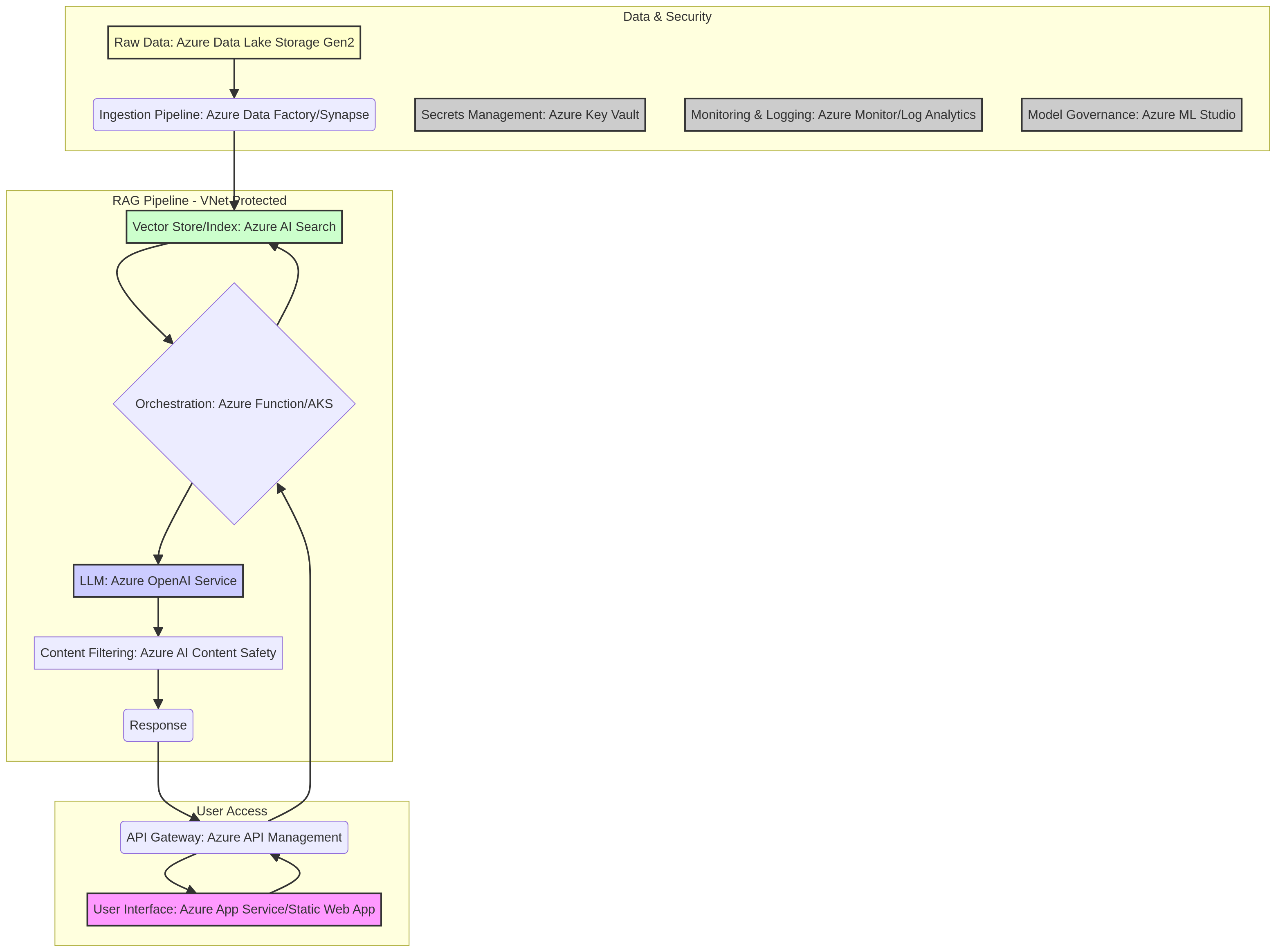
Architecture Diagram

PRJ-AZURE-AI-051 Architecture

Technology Stack

Azure OpenAI
Cognitive Search
Cosmos DB
RAG
GPT-4

Complete Documentation

Prerequisites

Contributor or Owner role
Azure CLI 2.x configured
Terraform >= 1.5 (optional)
Active Azure subscription
Service Principal with RBAC
1

Clone & Authenticate

Clone the repository and authenticate with Azure CLI using your service principal or interactive login.

az login && az account set --subscription 
2

Review RBAC Assignments

Review the required role assignments and ensure your identity has the correct permissions in the target resource group.

az role assignment list --assignee 
3

Initialize Infrastructure

Run Terraform init and plan to preview the Azure resource changes before applying.

terraform init && terraform plan -out=tfplan
4

Deploy Resources

Apply the Terraform plan to provision all Azure resources in your target subscription.

terraform apply tfplan
5

Verify & Monitor

Verify the deployment in the Azure Portal and check Azure Monitor for any alerts or issues.

az monitor activity-log list --resource-group 

Deployment Guide

Step-by-step instructions to deploy this project

Download Guide

Architecture Diagram

Visual representation of the system architecture

Download Architecture

Source Code

Complete source code and configuration files

View on GitHub

Video Tutorial

Watch the complete walkthrough video

Watch Now