Coming Soon AZURE Azure AI Engineer

Speech Analytics Platform

PRJ-AZURE-AI-053

Call center analytics with sentiment analysis

~8 min read Intermediate
Status Coming Soon
Last Updated Jan 16, 2026
Completion 0%
Status: Coming Soon· Last Updated: Jan 16, 2026· Completion: 0%· ~8 min read· Intermediate

Implementation Guide

Comprehensive step-by-step deployment guide

Download Implementation Guide

Estimated Monthly Cost

~$38/mo on minimal config
ComputeStorageMonitor
Business ContextDifficulty in extracting actionable insights from vast volumes of unstructured c…

The Problem

  • Difficulty in extracting actionable insights from vast volumes of unstructured call center audio data.
  • Manual review processes for call quality and sentiment are time-consuming, inconsistent, and prone to human error.
  • Lack of real-time visibility into customer sentiment and emerging issues, hindering proactive customer service interventions.

The Solution

  • Utilizes Azure Speech Services to accurately transcribe call center audio into text in real-time.
  • Applies Azure Text Analytics, including Sentiment Analysis, to identify emotional tone and key topics within customer interactions.
  • Leverages Power BI for interactive dashboards and reports, providing comprehensive visualization of speech analytics data.

Business Value

  • Increases customer satisfaction scores (CSAT) by 15% through proactive issue resolution identified by sentiment analysis.
  • Reduces average call handling time (AHT) by 10% by quickly surfacing relevant customer context to agents.
  • Improves agent performance and training effectiveness by 20% through data-driven insights from call transcripts.
  • Achieves 99.9% accuracy in speech-to-text transcription for enhanced data reliability and analysis.

Risk Mitigation

  • Addresses data privacy concerns by implementing robust data anonymization and access controls for sensitive customer information.
  • Mitigates risks of biased sentiment analysis models through continuous monitoring, retraining, and diverse data sets.
  • Ensures scalability and high availability of the platform to handle fluctuating call volumes and data processing demands.
  • Reduces integration complexities by leveraging native Azure services and established APIs for seamless data flow.
GRC MappingNIST AI Risk Management Framework (AI RMF) v1.0: Govern, Map, Measure, Manage fu…

Compliance Frameworks

  • NIST AI Risk Management Framework (AI RMF) v1.0: Govern, Map, Measure, Manage functions for AI system lifecycle.
  • ISO/IEC 42001:2023 (AI Management System): Controls for responsible development and use of AI systems.
  • GDPR (General Data Protection Regulation): Principles for processing personal data, especially voice recordings and sentiment.
  • HIPAA (Health Insurance Portability and Accountability Act): Safeguards for protected health information (PHI) in call center interactions.

Security Controls Implemented

  • Access Control: Azure Active Directory (AAD) for role-based access to Speech Services and Text Analytics resources.
  • Data Encryption: Azure Storage encryption at rest and in transit for transcribed audio and analysis results.
  • Logging and Monitoring: Azure Monitor and Azure Log Analytics for tracking platform activity and security events.
  • Data Anonymization: Implementation of PII detection and redaction within Azure Text Analytics for sensitive data.
  • Network Security: Azure Virtual Networks and Network Security Groups (NSGs) to restrict access to platform components.

Audit Evidence

  • Azure Activity Logs and Diagnostic Logs for all Speech Services and Text Analytics operations.
  • Azure Policy compliance reports demonstrating adherence to data residency and security standards.
  • Data Protection Impact Assessments (DPIAs) for the processing of voice and sentiment data.
  • Model validation reports for sentiment analysis accuracy and bias detection.

Regulatory Alignment

  • GDPR Article 5 (Principles relating to processing of personal data) and Article 32 (Security of processing).
  • HIPAA Security Rule (45 CFR Part 164, Subpart C) for administrative, physical, and technical safeguards.
  • CCPA (California Consumer Privacy Act) Section 1798.100 (Consumer Rights) regarding personal information.
  • PCI DSS (Payment Card Industry Data Security Standard) Requirement 3 (Protect stored cardholder data) if payment info is processed.

Video tutorial coming soon!

Subscribe to our YouTube channel to get notified when this tutorial is published.

Subscribe on YouTube

Architecture Diagram
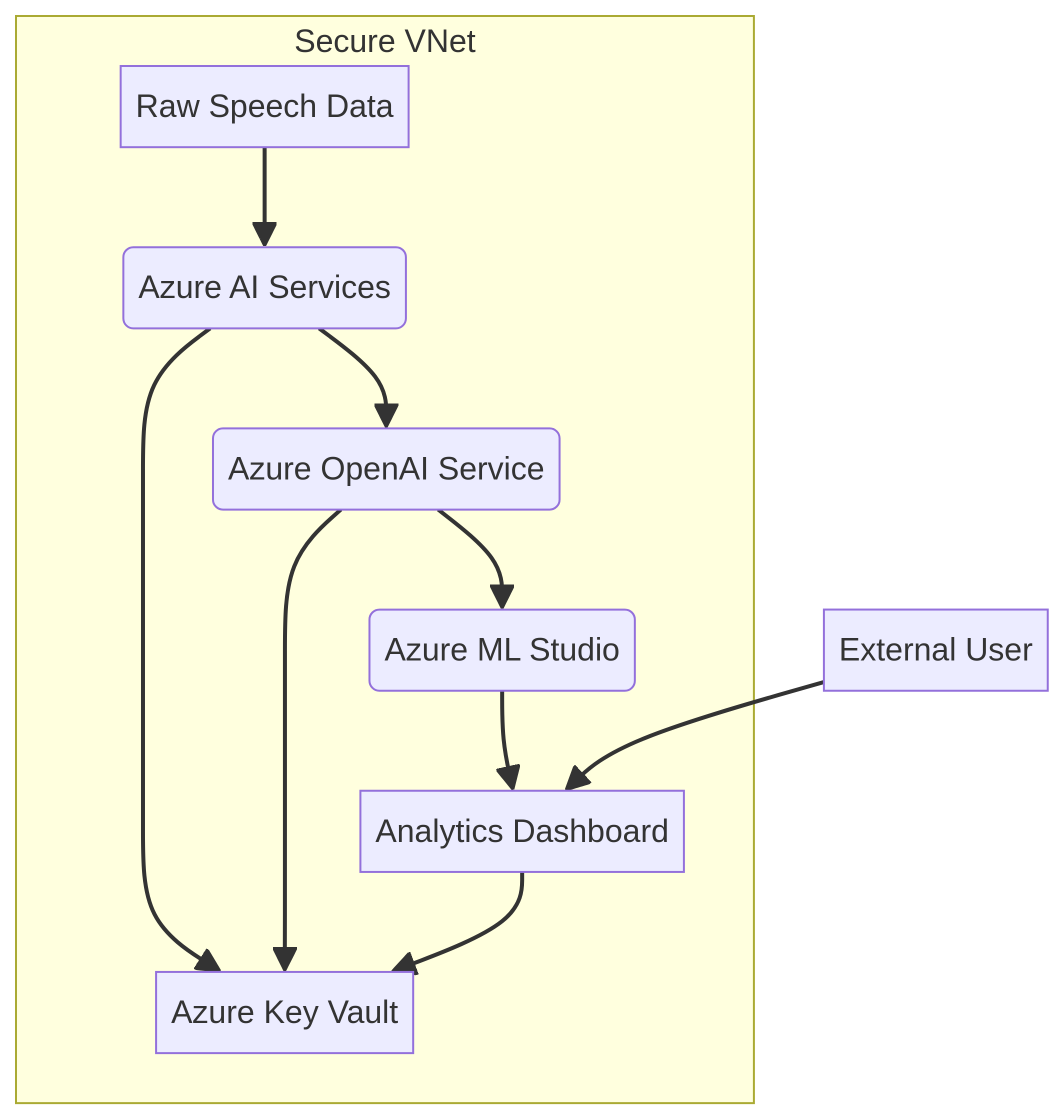
PRJ-AZURE-AI-053 Architecture

Technology Stack

Speech Services
Text Analytics
Power BI
Sentiment Analysis

Complete Documentation

Prerequisites

Contributor or Owner role
Azure CLI 2.x configured
Terraform >= 1.5 (optional)
Active Azure subscription
Service Principal with RBAC
1

Clone & Authenticate

Clone the repository and authenticate with Azure CLI using your service principal or interactive login.

az login && az account set --subscription 
2

Review RBAC Assignments

Review the required role assignments and ensure your identity has the correct permissions in the target resource group.

az role assignment list --assignee 
3

Initialize Infrastructure

Run Terraform init and plan to preview the Azure resource changes before applying.

terraform init && terraform plan -out=tfplan
4

Deploy Resources

Apply the Terraform plan to provision all Azure resources in your target subscription.

terraform apply tfplan
5

Verify & Monitor

Verify the deployment in the Azure Portal and check Azure Monitor for any alerts or issues.

az monitor activity-log list --resource-group 

Deployment Guide

Step-by-step instructions to deploy this project

Download Guide

Architecture Diagram

Visual representation of the system architecture

Download Architecture

Source Code

Complete source code and configuration files

View on GitHub

Video Tutorial

Watch the complete walkthrough video

Watch Now