Business Context
Understanding the real-world value and application
The Problem
- Lack of standardized processes for deploying and managing machine learning models leads to inconsistent performance and delayed time-to-market for AI solutions.
- Manual model retraining and redeployment are error-prone and resource-intensive, hindering the ability to adapt quickly to concept drift or new data patterns.
- Absence of robust version control and lineage tracking for ML models and data makes auditing, reproducibility, and compliance challenging.
The Solution
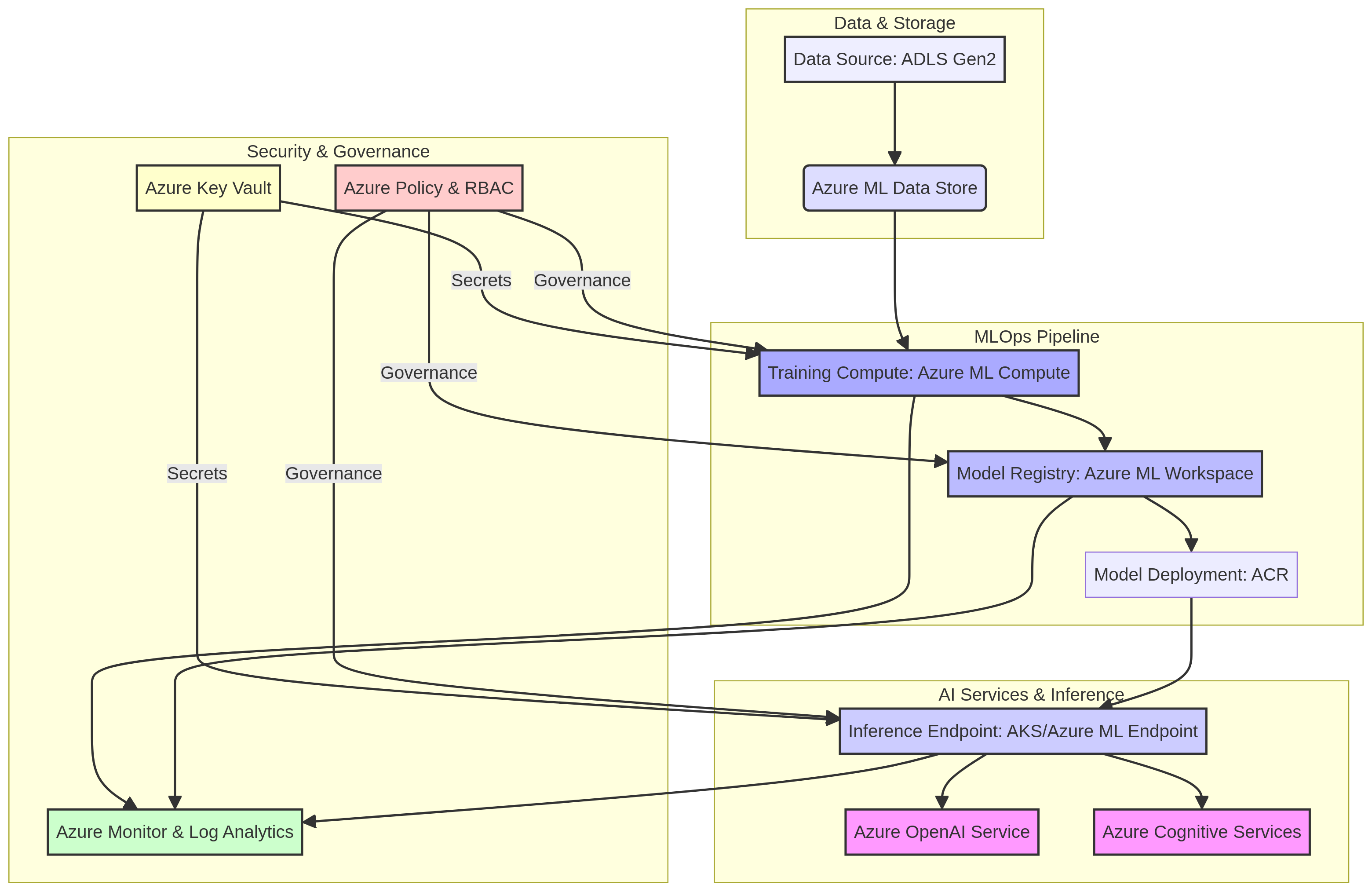
- Implementation of Azure ML Pipelines for automated, repeatable, and scalable model training, evaluation, and deployment workflows.
- Establishment of a centralized Model Registry within Azure ML to manage model versions, metadata, and approval processes.
- Integration with Azure DevOps Pipelines to orchestrate CI/CD for ML code, infrastructure, and model deployments, ensuring seamless operationalization.
Business Value
- Reduces model deployment time from an average of 4 weeks to 2 days, accelerating innovation by 90%.
- Increases model retraining frequency by 5x, improving model accuracy and relevance by 15% over 6 months.
- Achieves 99.9% uptime for critical ML inference services through automated monitoring and rollback capabilities.
- Lowers operational costs associated with manual ML lifecycle management by 30% through automation.
Risk Mitigation
- Mitigates risks of model drift and degradation through continuous monitoring and automated retraining triggers.
- Reduces human error in deployment and configuration via Infrastructure as Code (IaC) and automated pipelines.
- Addresses compliance risks by providing full audit trails and versioning for all model artifacts and experiments.
- Enhances security posture by integrating vulnerability scanning into DevOps Pipelines for ML dependencies.