Coming Soon AZURE Azure Data Engineer

Data Governance with Purview

PRJ-AZURE-DATA-075

Enterprise data governance and cataloging

~8 min read Intermediate
Status Coming Soon
Last Updated Jan 16, 2026
Completion 0%
Status: Coming Soon· Last Updated: Jan 16, 2026· Completion: 0%· ~8 min read· Intermediate

Implementation Guide

Comprehensive step-by-step deployment guide

Download Implementation Guide

Estimated Monthly Cost

~$42/mo on minimal config
Synapse $18Data Factory $10Storage $8Monitor $6
Business ContextOrganizations struggle with fragmented data silos and disparate tools, hindering…

The Problem

  • Organizations struggle with fragmented data silos and disparate tools, hindering end-to-end machine learning lifecycle management on Azure.
  • Lack of a unified platform for data engineering, machine learning development, and MLOps leads to inefficiencies, slow model deployment, and inconsistent results.
  • Scaling Apache Spark workloads for large-scale data processing and machine learning training on Azure often involves complex infrastructure management and optimization challenges.

The Solution

  • Implementation of Azure Databricks as a unified analytics platform, integrating data engineering, data science, and machine learning workflows.
  • Leveraging MLflow for experiment tracking, model management, and reproducible machine learning lifecycle, ensuring version control and auditability of models.
  • Utilizing Delta Lake on Azure Data Lake Storage for reliable, high-performance data lakes, enabling ACID transactions and schema enforcement for data quality.

Business Value

  • Reduces model deployment time by 60%, from weeks to days, accelerating time-to-market for new ML capabilities.
  • Improves data scientist productivity by 30% through a unified platform and streamlined MLOps workflows.
  • Achieves 99.9% data pipeline uptime SLA by leveraging Azure Databricks' managed services and Delta Lake's reliability features.
  • Increases accuracy of predictive models by 15% through enhanced data quality and efficient hyperparameter tuning with MLflow.

Risk Mitigation

  • Mitigates data inconsistency risks through Delta Lake's ACID transactions and schema evolution capabilities.
  • Addresses operational complexity and infrastructure management risks by utilizing Azure Databricks as a fully managed service.
  • Reduces model drift and performance degradation risks through continuous monitoring and reproducible deployments facilitated by MLflow.
  • Enhances data security and access control by integrating with Azure Active Directory and network isolation features within Azure Databricks.
GRC MappingNIST AI RMF (AI Risk Management Framework): Addresses responsible AI development…

Compliance Frameworks

  • NIST AI RMF (AI Risk Management Framework): Addresses responsible AI development and deployment, particularly for ML models.
  • ISO 42001 (AI Management System): Provides a framework for managing AI systems, ensuring ethical and trustworthy AI.
  • ISO 27001 (Information Security Management): Ensures robust information security practices for data processed and stored within Azure Databricks.
  • GDPR (General Data Protection Regulation): Governs the processing of personal data, relevant for data used in ML models.

Security Controls Implemented

  • Access Control: Azure Active Directory integration for granular role-based access control (RBAC) to Azure Databricks workspaces and data.
  • Data Encryption: Data at rest encrypted using Azure Storage Service Encryption and data in transit secured via TLS/SSL within Azure Databricks.
  • Network Isolation: Azure Virtual Network (VNet) injection for Azure Databricks workspaces, ensuring private connectivity and isolation from public internet.
  • Audit Logging: Comprehensive audit logs generated by Azure Databricks and Azure Monitor, tracking all user activities and data access.
  • Model Versioning & Lineage: MLflow Tracking and Model Registry provide immutable versioning and lineage for all machine learning models, ensuring reproducibility and auditability.

Audit Evidence

  • Azure Databricks audit logs and diagnostic settings for user activity and cluster events.
  • MLflow experiment runs and model registry entries detailing model development, training, and deployment.
  • Azure Policy compliance reports for resource configurations and security standards adherence.
  • Azure Security Center recommendations and secure score reports for overall cloud security posture.

Regulatory Alignment

  • GDPR Article 5 (Principles relating to processing of personal data): Ensures data minimization, purpose limitation, and accuracy for ML training data.
  • GDPR Article 32 (Security of processing): Implements technical and organizational measures to ensure a level of security appropriate to the risk of data processing.
  • HIPAA Security Rule (45 CFR Part 164, Subpart C): Protects electronic protected health information (ePHI) when processing healthcare-related data in ML models.
  • California Consumer Privacy Act (CCPA) Section 1798.100 (Consumer Rights): Supports consumer rights regarding personal information collected and processed by ML systems.

Video tutorial coming soon!

Subscribe to our YouTube channel to get notified when this tutorial is published.

Subscribe on YouTube

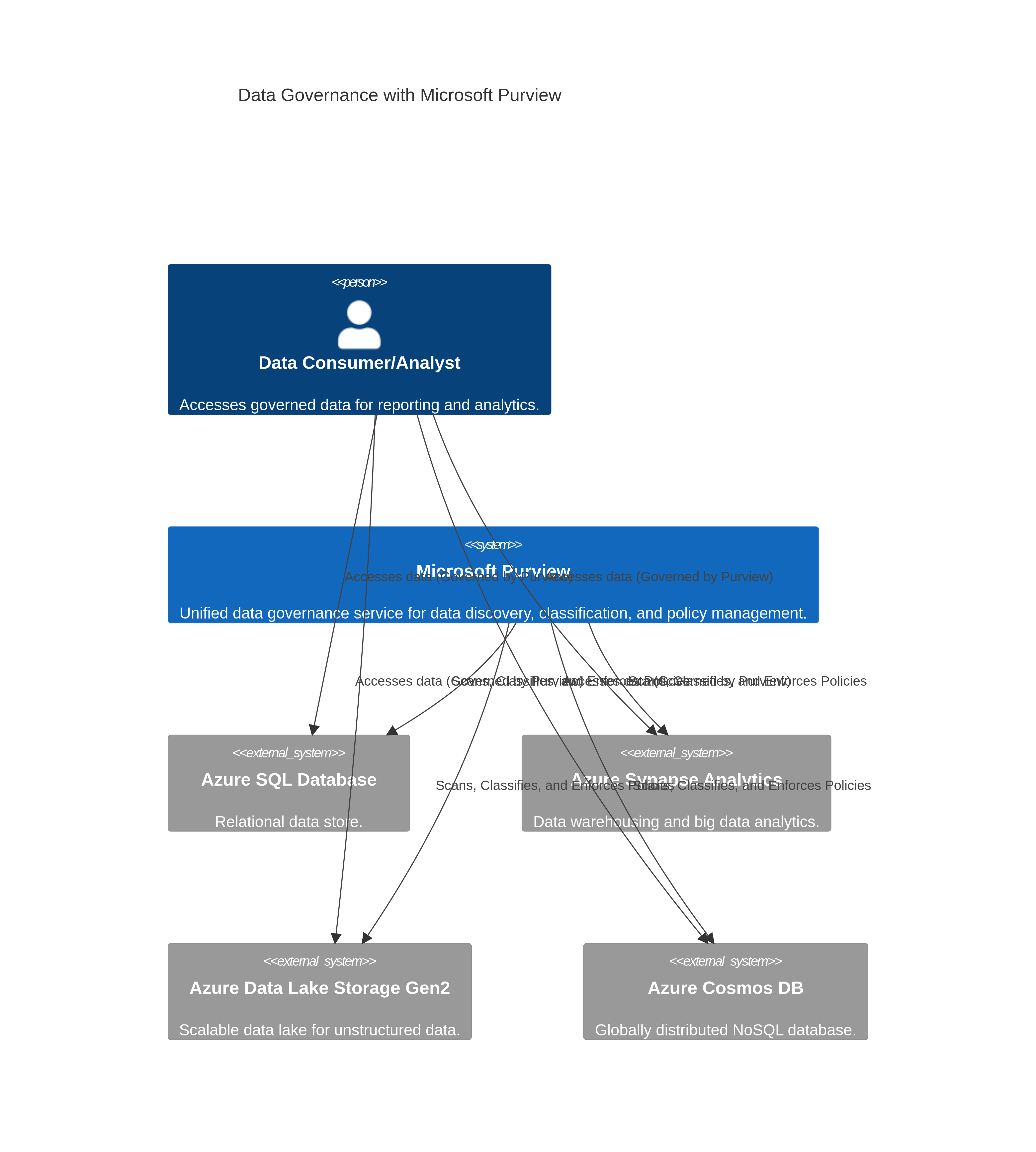
Architecture Diagram

PRJ-AZURE-DATA-075 Architecture

Technology Stack

Purview
Data Catalog
Lineage
Classification
Governance

Complete Documentation

Prerequisites

Contributor or Owner role
Azure CLI 2.x configured
Terraform >= 1.5 (optional)
Active Azure subscription
Service Principal with RBAC
1

Clone & Authenticate

Clone the repository and authenticate with Azure CLI using your service principal or interactive login.

az login && az account set --subscription 
2

Review RBAC Assignments

Review the required role assignments and ensure your identity has the correct permissions in the target resource group.

az role assignment list --assignee 
3

Initialize Infrastructure

Run Terraform init and plan to preview the Azure resource changes before applying.

terraform init && terraform plan -out=tfplan
4

Deploy Resources

Apply the Terraform plan to provision all Azure resources in your target subscription.

terraform apply tfplan
5

Verify & Monitor

Verify the deployment in the Azure Portal and check Azure Monitor for any alerts or issues.

az monitor activity-log list --resource-group 

Deployment Guide

Step-by-step instructions to deploy this project

Download Guide

Architecture Diagram

Visual representation of the system architecture

Download Architecture

Source Code

Complete source code and configuration files

View on GitHub

Video Tutorial

Watch the complete walkthrough video

Watch Now