Coming Soon AZURE Azure DevOps Engineer

Infrastructure as Code with Bicep

PRJ-AZURE-DEVOPS-068

Declarative infrastructure management

~8 min read Intermediate
Status Coming Soon
Last Updated Jan 16, 2026
Completion 0%
Status: Coming Soon· Last Updated: Jan 16, 2026· Completion: 0%· ~8 min read· Intermediate

Implementation Guide

Comprehensive step-by-step deployment guide

Download Implementation Guide

Estimated Monthly Cost

~$30/mo on minimal config
Pipelines $12AKS $10Container Reg $5Monitor $3
Business ContextManual provisioning of Azure resources leads to configuration drift, inconsisten…

The Problem

  • Manual provisioning of Azure resources leads to configuration drift, inconsistent environments, and increased human error, slowing down deployment cycles.
  • Lack of version control and standardized deployment practices for infrastructure makes auditing changes difficult and hinders rapid recovery from misconfigurations.
  • Complex interdependencies between Azure resources are challenging to manage and visualize without a declarative approach, leading to deployment failures and extended troubleshooting.

The Solution

  • Implements Azure Bicep templates for defining and deploying Azure infrastructure in a declarative and idempotent manner.
  • Utilizes Azure DevOps Pipelines to automate the continuous integration and continuous deployment (CI/CD) of infrastructure changes, ensuring consistency across environments.
  • Establishes a centralized repository for ARM Templates and Bicep code, enabling version control, peer review, and automated validation of infrastructure definitions.

Business Value

  • Reduces infrastructure deployment time by 70%, from days to hours, through automation and standardized templates.
  • Achieves a 95% reduction in configuration drift across environments, ensuring consistency from development to production.
  • Improves auditability and compliance by providing a complete, version-controlled history of all infrastructure changes, reducing audit preparation time by 50%.
  • Increases operational efficiency by automating resource provisioning, leading to a 30% decrease in manual effort for infrastructure management.

Risk Mitigation

  • Mitigates the risk of human error in infrastructure provisioning through automated, validated Bicep deployments.
  • Reduces security vulnerabilities by enforcing security best practices and compliance policies directly within Bicep templates.
  • Addresses the risk of vendor lock-in by using open-source Bicep and standard ARM Templates, allowing for easier migration if needed.
  • Minimizes downtime risk by enabling rapid, consistent recovery of infrastructure through version-controlled IaC.
GRC MappingISO 27001:2022(Information Security Management) - Annex A.8.1 (Information secur…

Compliance Frameworks

  • ISO 27001:2022 (Information Security Management) - Annex A.8.1 (Information security policy)
  • NIST SP 800-53 Rev. 5 (Security and Privacy Controls) - CM-2 (Baseline Configuration)
  • CIS Controls v8 (Critical Security Controls) - Control 3 (Data Protection)
  • SOC 2 Type 2 (Security, Availability, Processing Integrity, Confidentiality, Privacy) - Common Criteria CC6.1 (Logical and Physical Access Controls)

Security Controls Implemented

  • Azure Policy enforcement for resource configuration compliance within Bicep deployments.
  • Azure DevOps branch policies requiring peer review for all Bicep template changes.
  • Azure Key Vault integration for secure management of secrets and certificates used in IaC deployments.
  • Azure Monitor logging and alerting for infrastructure deployment activities and configuration changes.
  • Role-Based Access Control (RBAC) defined within Bicep templates to restrict access to Azure resources.

Audit Evidence

  • Azure DevOps Pipeline execution logs detailing IaC deployments.
  • Version-controlled Bicep and ARM Template files in Azure Repos.
  • Azure Policy compliance reports for deployed resources.
  • Audit trails from Azure Activity Log for resource creation and modification events.

Regulatory Alignment

  • GDPR (General Data Protection Regulation) - Article 25 (Data protection by design and by default)
  • HIPAA (Health Insurance Portability and Accountability Act) - 164.308(a)(1)(ii)(D) (Information System Activity Review)
  • PCI DSS v4.0 (Payment Card Industry Data Security Standard) - Requirement 2.2 (Secure configuration standards)
  • SOX (Sarbanes-Oxley Act) - Section 302 (Corporate Responsibility for Financial Reports)

Video tutorial coming soon!

Subscribe to our YouTube channel to get notified when this tutorial is published.

Subscribe on YouTube

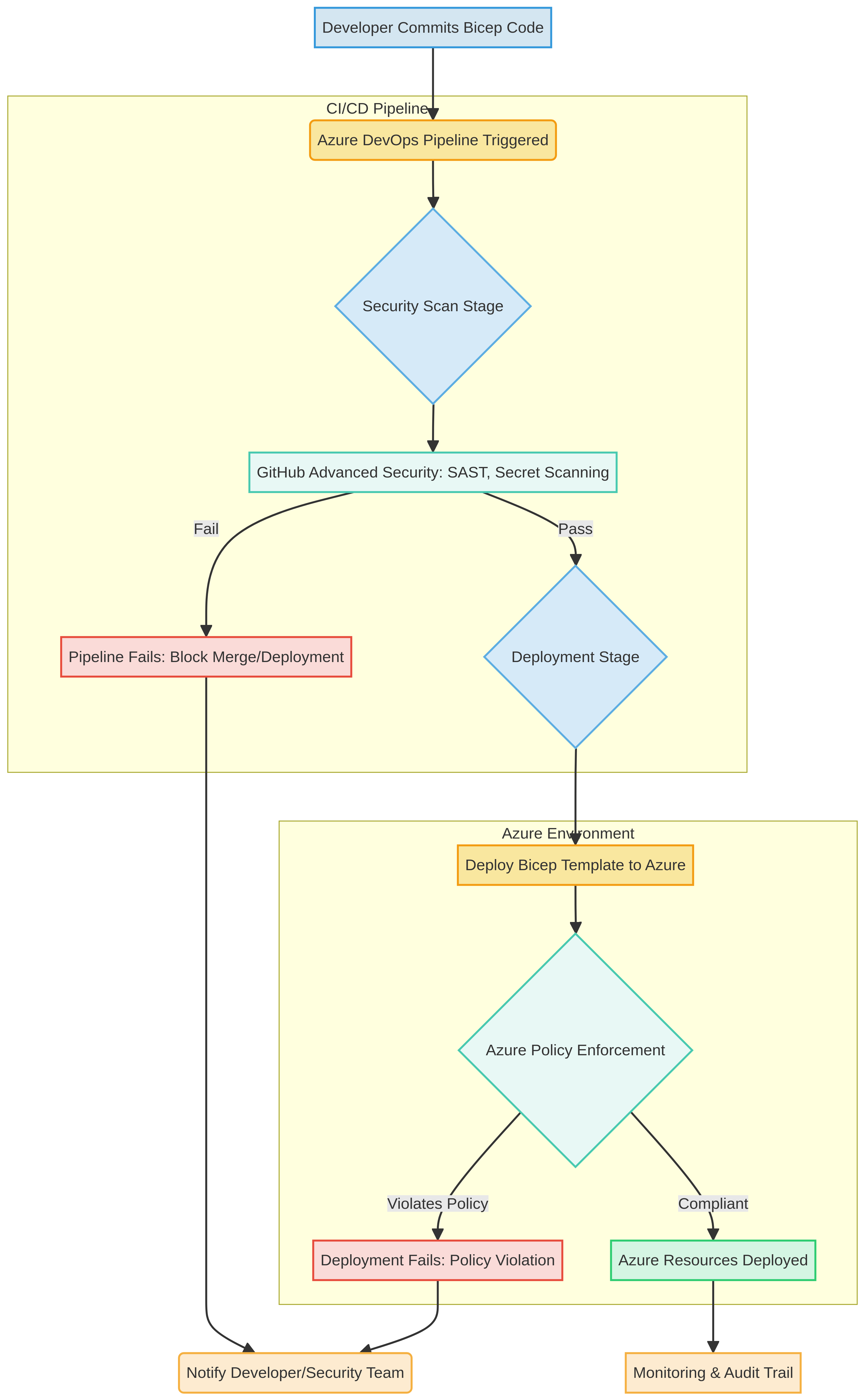
Architecture Diagram

PRJ-AZURE-DEVOPS-068 Architecture

Technology Stack

Bicep
ARM Templates
Azure DevOps
IaC

Complete Documentation

Prerequisites

Contributor or Owner role
Azure CLI 2.x configured
Terraform >= 1.5 (optional)
Active Azure subscription
Service Principal with RBAC
1

Clone & Authenticate

Clone the repository and authenticate with Azure CLI using your service principal or interactive login.

az login && az account set --subscription 
2

Review RBAC Assignments

Review the required role assignments and ensure your identity has the correct permissions in the target resource group.

az role assignment list --assignee 
3

Initialize Infrastructure

Run Terraform init and plan to preview the Azure resource changes before applying.

terraform init && terraform plan -out=tfplan
4

Deploy Resources

Apply the Terraform plan to provision all Azure resources in your target subscription.

terraform apply tfplan
5

Verify & Monitor

Verify the deployment in the Azure Portal and check Azure Monitor for any alerts or issues.

az monitor activity-log list --resource-group 

Deployment Guide

Step-by-step instructions to deploy this project

Download Guide

Architecture Diagram

Visual representation of the system architecture

Download Architecture

Source Code

Complete source code and configuration files

View on GitHub

Video Tutorial

Watch the complete walkthrough video

Watch Now