Coming Soon AZURE Azure DevOps Engineer

GitOps with Flux and AKS

PRJ-AZURE-DEVOPS-071

Declarative Kubernetes management

~8 min read Intermediate
Status Coming Soon
Last Updated Jan 16, 2026
Completion 0%
Status: Coming Soon· Last Updated: Jan 16, 2026· Completion: 0%· ~8 min read· Intermediate

Estimated Monthly Cost

~$30/mo on minimal config
Pipelines $12AKS $10Container Reg $5Monitor $3
Business ContextManual and inconsistent Kubernetes deployments leading to configuration drift an…

The Problem

  • Manual and inconsistent Kubernetes deployments leading to configuration drift and operational inefficiencies.
  • Slow and error-prone release cycles for containerized applications due to complex orchestration and lack of automation.
  • Lack of clear audit trails and traceability for infrastructure changes, hindering compliance and troubleshooting efforts.

The Solution

  • Implements Flux CD for continuous delivery and automated reconciliation of Kubernetes cluster state from Git repositories.
  • Utilizes Azure Kubernetes Service (AKS) for managed Kubernetes clusters, providing scalable and reliable container orchestration.
  • Integrates with Azure DevOps pipelines for automated build, test, and deployment workflows, pushing changes to Git.

Business Value

  • Reduces deployment failure rates by 70% through automated, declarative configurations.
  • Accelerates application delivery cycles by 50%, enabling faster time-to-market for new features.
  • Improves operational efficiency by automating infrastructure as code, saving 20% in manual effort.
  • Enhances system stability and reliability, achieving 99.95% uptime for critical applications.

Risk Mitigation

  • Mitigates configuration drift by enforcing desired state through Git as the single source of truth.
  • Reduces human error in deployments through automated, repeatable processes and GitOps principles.
  • Addresses security vulnerabilities by integrating container image scanning in Azure Container Registry (ACR) and policy enforcement in AKS.
  • Ensures disaster recovery readiness through declarative infrastructure definitions stored in Git.
GRC MappingISO 27001: A.12.1.2 (Change Management) - Ensuring controlled changes to systems…

Compliance Frameworks

  • ISO 27001: A.12.1.2 (Change Management) - Ensuring controlled changes to systems.
  • NIST SP 800-53: CM-3 (Configuration Management) - Maintaining baseline configurations.
  • SOC 2 Type 2: Common Criteria CC6.1 (Logical and Physical Access Controls) - Managing access to system components.
  • CSA CCM v4: AIS-04 (Application Security) - Securing application development and deployment.

Security Controls Implemented

  • Declarative configuration management enforced by Flux CD for all Kubernetes resources.
  • Role-Based Access Control (RBAC) in AKS to restrict access to cluster resources.
  • Automated vulnerability scanning of container images in Azure Container Registry (ACR).
  • Policy enforcement within AKS using Azure Policy to ensure compliance with organizational standards.
  • Version control and audit logging for all infrastructure changes within Azure DevOps Git repositories.

Audit Evidence

  • Git commit history and pull request approvals for all infrastructure and application changes.
  • Azure DevOps pipeline execution logs demonstrating automated deployment processes.
  • ACR vulnerability scan reports for deployed container images.
  • AKS audit logs detailing access and actions within the Kubernetes cluster.

Regulatory Alignment

  • GDPR: Article 25 (Data Protection by Design and by Default) - Through secure configuration and access controls.
  • HIPAA: 164.308(a)(1)(ii)(D) (Information System Activity Review) - Enabled by comprehensive logging and audit trails.
  • PCI DSS v4.0: Requirement 6.3.2 (Secure Software Development Life Cycle) - Supported by GitOps and automated pipelines.
  • SOX: Section 302 (Corporate Responsibility for Financial Reports) - Enhanced by transparent and auditable infrastructure changes.

Video tutorial coming soon!

Subscribe to our YouTube channel to get notified when this tutorial is published.

Subscribe on YouTube

Architecture Diagram
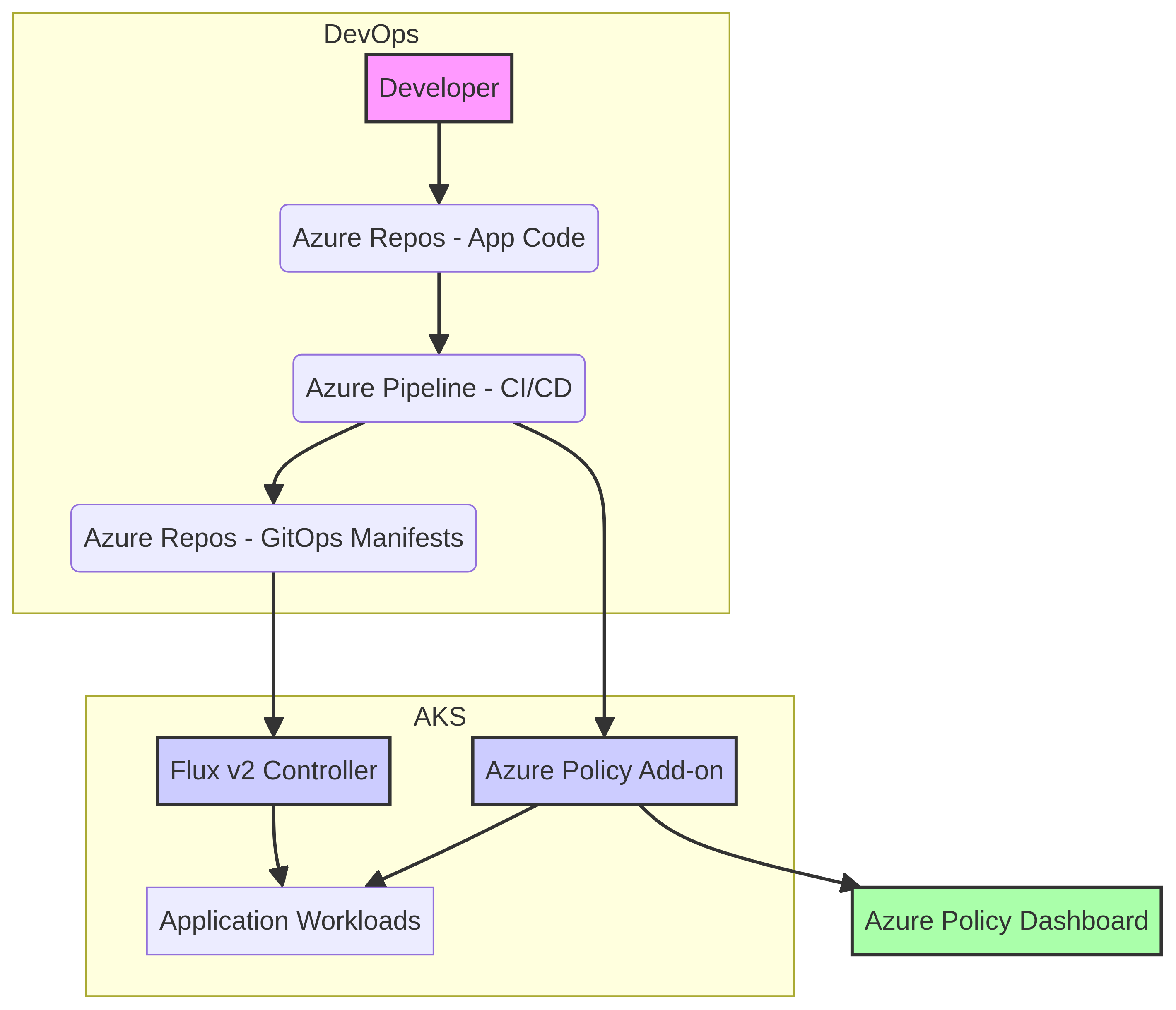
PRJ-AZURE-DEVOPS-071 Architecture

Technology Stack

AKS
Flux
Azure DevOps
ACR
GitOps

Complete Documentation

Prerequisites

Contributor or Owner role
Azure CLI 2.x configured
Terraform >= 1.5 (optional)
Active Azure subscription
Service Principal with RBAC
1

Clone & Authenticate

Clone the repository and authenticate with Azure CLI using your service principal or interactive login.

az login && az account set --subscription 
2

Review RBAC Assignments

Review the required role assignments and ensure your identity has the correct permissions in the target resource group.

az role assignment list --assignee 
3

Initialize Infrastructure

Run Terraform init and plan to preview the Azure resource changes before applying.

terraform init && terraform plan -out=tfplan
4

Deploy Resources

Apply the Terraform plan to provision all Azure resources in your target subscription.

terraform apply tfplan
5

Verify & Monitor

Verify the deployment in the Azure Portal and check Azure Monitor for any alerts or issues.

az monitor activity-log list --resource-group 

Deployment Guide

Step-by-step instructions to deploy this project

Download Guide

Architecture Diagram

Visual representation of the system architecture

Download Architecture

Source Code

Complete source code and configuration files

View on GitHub

Video Tutorial

Watch the complete walkthrough video

Watch Now