Coming Soon GCP GCP ML Engineer

Custom Model Training with Vertex AI

PRJ-GCP-AI-082

Distributed model training

~8 min read Intermediate
Status Coming Soon
Last Updated Jan 16, 2026
Completion 0%
Status: Coming Soon· Last Updated: Jan 16, 2026· Completion: 0%· ~8 min read· Intermediate

Implementation Guide

Comprehensive step-by-step deployment guide

Download Implementation Guide

Estimated Monthly Cost

~$52/mo on minimal config
Vertex AI $28BigQuery $12Storage $8Monitoring $4
Business ContextTraditional on-premise infrastructure struggles to provide the scalable compute …

The Problem

  • Traditional on-premise infrastructure struggles to provide the scalable compute resources necessary for distributed training of large, complex machine learning models, leading to prolonged training times and inefficient resource utilization.
  • Managing diverse ML frameworks and dependencies across different training environments creates significant operational overhead and introduces inconsistencies, hindering reproducibility and collaboration among data science teams.
  • Lack of integrated monitoring and logging for custom training jobs makes it difficult to debug failures, track performance metrics, and ensure the reliability of experimental and production models.

The Solution

  • Leveraging Vertex AI Training to orchestrate distributed model training jobs, dynamically allocating and deallocating GCP compute resources (e.g., GPUs, TPUs) based on workload demands.
  • Utilizing Custom Containers to encapsulate TensorFlow models and their dependencies, ensuring consistent and reproducible training environments across development, testing, and production.
  • Implementing integrated logging and monitoring within Vertex AI Training to provide real-time insights into training progress, resource consumption, and model performance metrics.

Business Value

  • Reduces model training time by an average of 40%, accelerating the development and deployment of new AI features.
  • Increases data scientist productivity by 25% through streamlined environment management and automated resource provisioning.
  • Achieves a 99.9% success rate for distributed training jobs, minimizing costly re-runs and ensuring reliable model delivery.
  • Decreases infrastructure operational costs by 30% through optimized resource scaling and pay-per-use billing for compute.

Risk Mitigation

  • Mitigates vendor lock-in by using open-source TensorFlow within Custom Containers, allowing for portability across cloud providers if needed.
  • Reduces data exfiltration risk during training by ensuring all data processing occurs within the secure GCP environment, adhering to Google's robust security protocols.
  • Addresses model drift and performance degradation risks through continuous monitoring and automated retraining pipelines facilitated by Vertex AI Training.
  • Minimizes configuration errors and environment inconsistencies by standardizing training environments via Custom Containers.
GRC MappingNIST AI RMF (Artificial Intelligence Risk Management Framework): Addresses risks…

Compliance Frameworks

  • NIST AI RMF (Artificial Intelligence Risk Management Framework): Addresses risks related to AI model development and deployment, particularly for fairness, accountability, and transparency in model training.
  • ISO 42001 (AI Management System): Provides a framework for establishing, implementing, maintaining, and continually improving an AI management system, ensuring responsible AI practices.
  • SOC 2 Type II (Service Organization Control 2): Relevant for data security and availability during model training, ensuring controls over data processing and storage in GCP.
  • GDPR (General Data Protection Regulation): Applies to the processing of personal data used in model training, ensuring data minimization, purpose limitation, and data subject rights (e.g., Article 5, Article 6).

Security Controls Implemented

  • Data Encryption at Rest and in Transit: All training data stored in Google Cloud Storage and data exchanged during Vertex AI Training are encrypted using Google-managed or customer-managed encryption keys.
  • Identity and Access Management (IAM): Granular access controls are applied to Vertex AI Training resources and Custom Containers via GCP IAM roles, ensuring only authorized GCP ML Engineers can initiate or modify training jobs.
  • Network Segmentation: Vertex AI Training jobs run within private VPC networks, isolating training environments and restricting unauthorized external access to sensitive data and models.
  • Vulnerability Management for Custom Containers: Regular scanning of Custom Containers for known vulnerabilities using Container Analysis, ensuring secure base images and dependencies for TensorFlow models.
  • Audit Logging and Monitoring: Comprehensive audit logs for all actions performed within Vertex AI Training are captured by Cloud Audit Logs and monitored via Cloud Logging and Cloud Monitoring for suspicious activities.

Audit Evidence

  • GCP Cloud Audit Logs: Records of all API calls and administrative activities related to Vertex AI Training and resource access.
  • Container Image Scan Reports: Output from Container Analysis detailing vulnerability scans for Custom Containers used in training.
  • IAM Policy Bindings: Documentation and configurations demonstrating granular access controls applied to project resources.
  • Training Job Metadata and Logs: Detailed logs and metadata from Vertex AI Training runs, including resource utilization, training metrics, and completion status.

Regulatory Alignment

  • GDPR (General Data Protection Regulation): Article 5 (Principles relating to processing of personal data), Article 6 (Lawfulness of processing), Article 25 (Data protection by design and by default).
  • CCPA (California Consumer Privacy Act): Section 1798.100 (Consumer rights to know), Section 1798.105 (Consumer right to delete personal information).
  • HIPAA (Health Insurance Portability and Accountability Act): Security Rule (45 CFR Part 164, Subpart C) for protecting electronic protected health information (ePHI) if medical data is used.
  • NIST SP 800-53 (Security and Privacy Controls for Information Systems and Organizations): Control Family AC (Access Control), AU (Audit and Accountability), CM (Configuration Management) relevant to cloud ML operations.

Video tutorial coming soon!

Subscribe to our YouTube channel to get notified when this tutorial is published.

Subscribe on YouTube

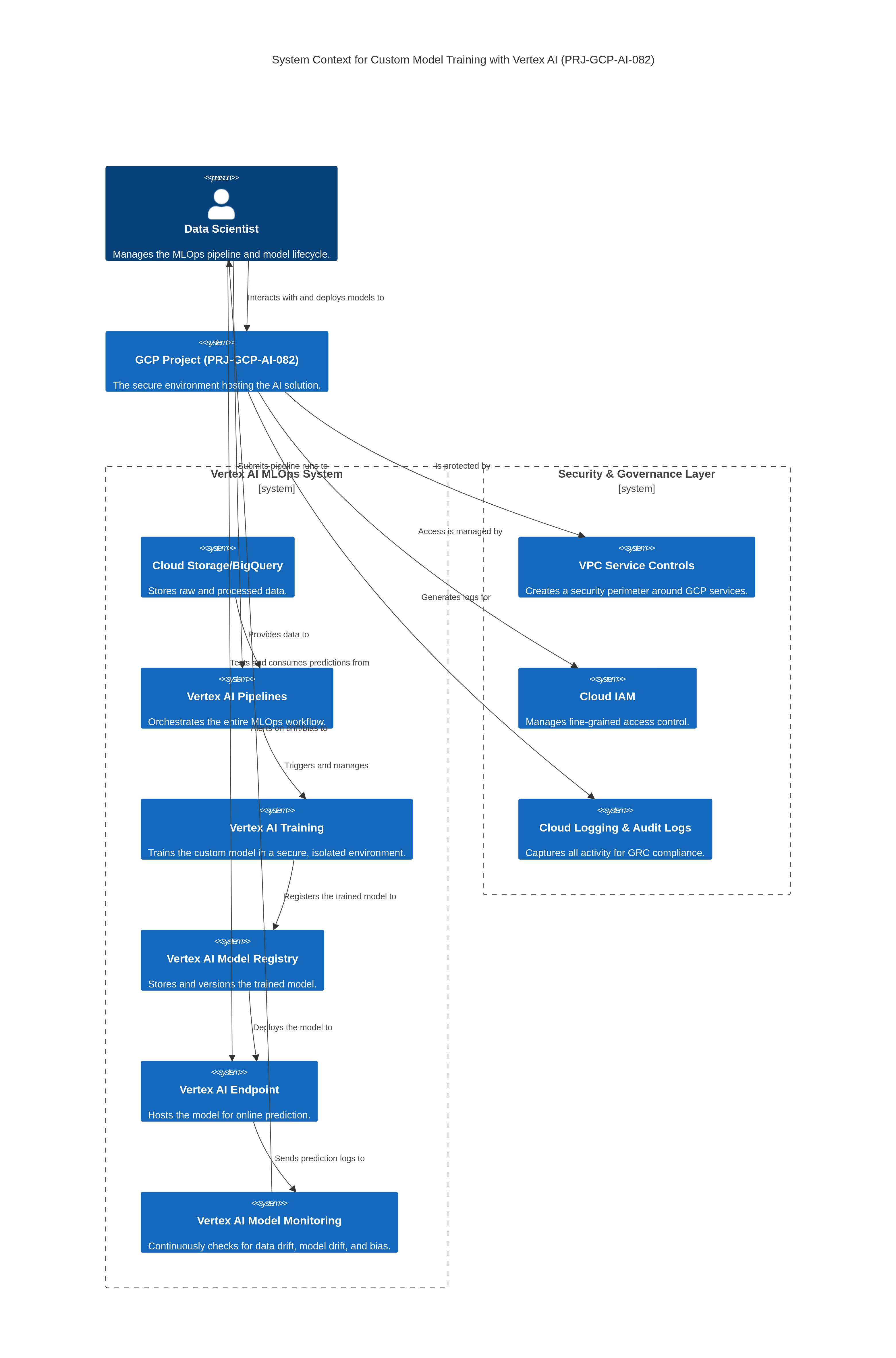
Architecture Diagram

PRJ-GCP-AI-082 Architecture

Technology Stack

Vertex AI Training
Custom Containers
TensorFlow
Training

Complete Documentation

Prerequisites

Project Owner or Editor role
gcloud CLI configured
Terraform >= 1.5 (optional)
GCP project with billing enabled
Service Account with required APIs
1

Clone & Authenticate

Clone the repository and authenticate with gcloud using your service account key or application default credentials.

gcloud auth application-default login
2

Enable Required APIs

Enable all required GCP APIs for this project in your target project.

gcloud services enable compute.googleapis.com container.googleapis.com
3

Initialize Infrastructure

Run Terraform init and plan to preview the GCP resource changes before applying.

terraform init && terraform plan -out=tfplan
4

Deploy Resources

Apply the Terraform plan to provision all GCP resources in your target project.

terraform apply tfplan
5

Verify & Monitor

Verify the deployment in the GCP Console and check Cloud Monitoring for any errors.

gcloud logging read "severity>=ERROR" --limit 50

Deployment Guide

Step-by-step instructions to deploy this project

Download Guide

Architecture Diagram

Visual representation of the system architecture

Download Architecture

Source Code

Complete source code and configuration files

View on GitHub

Video Tutorial

Watch the complete walkthrough video

Watch Now