Coming Soon GCP GCP ML Engineer

Recommendations AI for E-Commerce

PRJ-GCP-AI-084

Personalized product recommendations

~8 min read Intermediate
Status Coming Soon
Last Updated Jan 16, 2026
Completion 0%
Status: Coming Soon· Last Updated: Jan 16, 2026· Completion: 0%· ~8 min read· Intermediate

Implementation Guide

Comprehensive step-by-step deployment guide

Download Implementation Guide

Estimated Monthly Cost

~$52/mo on minimal config
Vertex AI $28BigQuery $12Storage $8Monitoring $4
Business ContextE-commerce platforms struggle with generic product displays, leading to low cust…

The Problem

  • E-commerce platforms struggle with generic product displays, leading to low customer engagement and missed upselling opportunities due to irrelevant recommendations.
  • Building and maintaining highly personalized recommendation engines in-house is resource-intensive, requiring specialized ML expertise and significant infrastructure investment.
  • Existing recommendation systems often lack the scalability and real-time processing capabilities needed to adapt to rapidly changing customer preferences and inventory.

The Solution

  • Leveraging Google Cloud's Recommendations AI to deliver highly personalized product suggestions, enhancing the shopping experience for each customer.
  • Implementing BigQuery for scalable and efficient processing of vast e-commerce transaction and user behavior data, forming the foundation for recommendation models.
  • Deploying the recommendation inference service via Cloud Run, ensuring a serverless, auto-scaling, and cost-effective solution for real-time predictions.

Business Value

  • Increases conversion rates by an estimated 15-20% through more relevant product discovery.
  • Boosts average order value (AOV) by 10% by effectively surfacing complementary products.
  • Reduces infrastructure and operational costs for the recommendation engine by 30% through serverless architecture.
  • Accelerates time-to-market for new personalization strategies by 50%, enabling rapid A/B testing and deployment.

Risk Mitigation

  • Addresses data privacy concerns by implementing robust data governance and anonymization techniques within BigQuery.
  • Mitigates the risk of biased recommendations through continuous monitoring and explainable AI features of Recommendations AI.
  • Ensures high availability and scalability during peak traffic with Cloud Run's auto-scaling capabilities and GCP's global infrastructure.
  • Reduces vendor lock-in by utilizing open standards and modular GCP services, allowing for future flexibility and integration.
GRC MappingNIST AI RMF (AI Risk Management Framework): Guides the responsible development a…

Compliance Frameworks

  • NIST AI RMF (AI Risk Management Framework): Guides the responsible development and deployment of AI systems, focusing on governance, mapping, measuring, and managing AI risks.
  • ISO 27001 (Information Security Management): Provides a framework for managing information security, ensuring confidentiality, integrity, and availability of data processed by BigQuery and Recommendations AI.
  • GDPR (General Data Protection Regulation): Addresses data protection and privacy for individuals within the European Union, relevant for handling personalized user data in e-commerce.
  • PCI DSS (Payment Card Industry Data Security Standard): Ensures secure handling of credit card information, indirectly relevant for e-commerce platforms processing payments.

Security Controls Implemented

  • Data Encryption: All customer data stored in BigQuery is encrypted at rest by default, and data in transit is secured via TLS/SSL.
  • Identity and Access Management (IAM): Granular access controls are applied to BigQuery datasets, Cloud Run services, and Recommendations AI models, ensuring least privilege access.
  • Logging and Monitoring: Cloud Logging and Cloud Monitoring are configured to capture audit trails and system metrics for all GCP services, enabling real-time threat detection and incident response.
  • Vulnerability Management: Cloud Run containers are regularly scanned for vulnerabilities, and images are updated to ensure the recommendation service runs on secure foundations.
  • Data Anonymization/Pseudonymization: Sensitive customer identifiers within BigQuery are anonymized or pseudonymized before being used for model training and personalization.

Audit Evidence

  • GCP Audit Logs: Comprehensive logs from Cloud Audit Logs detailing administrative activities, data access, and system events across BigQuery, Cloud Run, and Recommendations AI.
  • IAM Policy Documents: Documentation of all IAM policies and roles assigned to project resources, demonstrating adherence to least privilege principles.
  • Security Configuration Reports: Automated reports from Security Command Center validating security posture and compliance against benchmarks for GCP services.
  • Data Flow Diagrams: Visual representations of data ingress, processing in BigQuery, and egress to Recommendations AI, illustrating data handling and protection measures.

Regulatory Alignment

  • GDPR Article 5 (Principles relating to processing of personal data): Ensures data minimization, purpose limitation, and accountability in handling user personalization data.
  • GDPR Article 25 (Data protection by design and by default): Implemented through privacy-enhancing technologies in BigQuery and secure-by-design principles for Cloud Run.
  • CCPA Section 1798.100 (Consumer Rights): Supports consumer rights regarding personal information collected for recommendations, including access and deletion.
  • PCI DSS Requirement 3 (Protect stored cardholder data): While not directly storing card data, the project's secure data practices align with the broader intent of protecting sensitive e-commerce data.

Video tutorial coming soon!

Subscribe to our YouTube channel to get notified when this tutorial is published.

Subscribe on YouTube

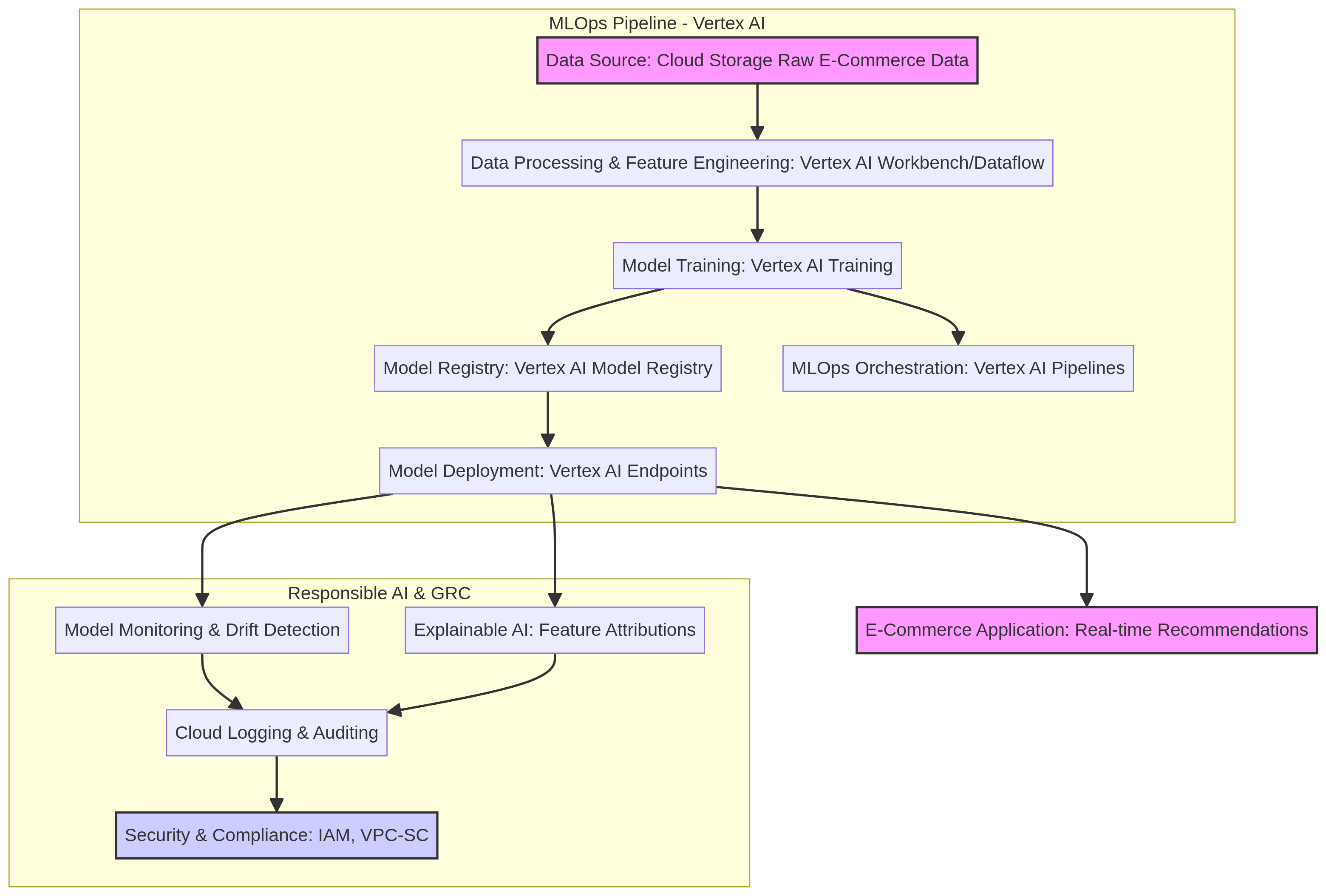
Architecture Diagram

PRJ-GCP-AI-084 Architecture

Technology Stack

Recommendations AI
BigQuery
Cloud Run
Personalization

Complete Documentation

Prerequisites

Project Owner or Editor role
gcloud CLI configured
Terraform >= 1.5 (optional)
GCP project with billing enabled
Service Account with required APIs
1

Clone & Authenticate

Clone the repository and authenticate with gcloud using your service account key or application default credentials.

gcloud auth application-default login
2

Enable Required APIs

Enable all required GCP APIs for this project in your target project.

gcloud services enable compute.googleapis.com container.googleapis.com
3

Initialize Infrastructure

Run Terraform init and plan to preview the GCP resource changes before applying.

terraform init && terraform plan -out=tfplan
4

Deploy Resources

Apply the Terraform plan to provision all GCP resources in your target project.

terraform apply tfplan
5

Verify & Monitor

Verify the deployment in the GCP Console and check Cloud Monitoring for any errors.

gcloud logging read "severity>=ERROR" --limit 50

Deployment Guide

Step-by-step instructions to deploy this project

Download Guide

Architecture Diagram

Visual representation of the system architecture

Download Architecture

Source Code

Complete source code and configuration files

View on GitHub

Video Tutorial

Watch the complete walkthrough video

Watch Now