Coming Soon GCP GCP Data Engineer

Data Lake with Cloud Storage and Dataproc

PRJ-GCP-DATA-078

Hadoop ecosystem on GCP

~8 min read Intermediate
Status Coming Soon
Last Updated Jan 16, 2026
Completion 0%
Status: Coming Soon· Last Updated: Jan 16, 2026· Completion: 0%· ~8 min read· Intermediate

Implementation Guide

Comprehensive step-by-step deployment guide

Download Implementation Guide

Estimated Monthly Cost

~$42/mo on minimal config
ComputeStorageMonitoring
Business ContextData Silos and Inefficient Processing: Organizations struggle with disparate dat…

The Problem

  • Data Silos and Inefficient Processing: Organizations struggle with disparate data sources, leading to data silos and complex, time-consuming data integration processes, hindering a unified view of business operations. Traditional on-premise Hadoop clusters often face scalability limitations and high operational overhead.
  • Costly Infrastructure Management: Managing and maintaining on-premises Hadoop ecosystems, including hardware provisioning, software patching, and cluster scaling, incurs significant operational costs and requires specialized expertise, diverting resources from core business innovation.
  • Delayed Data Insights: The inability to process large datasets quickly and efficiently, coupled with complex data transformations, results in significant delays in generating actionable insights, impacting timely decision-making and competitive responsiveness.

The Solution

  • Scalable Data Ingestion and Storage: Implemented a robust data lake using Cloud Storage to centralize diverse data sources, providing petabyte-scale, cost-effective, and highly durable storage for raw and processed data.
  • Managed Hadoop Ecosystem: Deployed a fully managed Dataproc cluster, leveraging its capabilities for running Spark and Hive workloads, thereby eliminating the operational burden of managing underlying infrastructure and enabling dynamic scaling.
  • Efficient Data Processing Pipelines: Established automated data processing pipelines utilizing Spark for high-performance data transformations and Hive for SQL-based querying over the data lake, ensuring timely data availability for analytics.

Business Value

  • Reduces Data Processing Time: Decreases batch processing times by 40% through elastic scaling of Dataproc clusters, enabling faster data availability for business intelligence.
  • Lowers Infrastructure Costs: Achieves a 25% reduction in total cost of ownership (TCO) by migrating from on-premises Hadoop to managed Cloud Storage and Dataproc services.
  • Improves Data Accessibility: Increases data accessibility for analysts and data scientists by 60%, providing a unified view of enterprise data through a centralized data lake.
  • Enhances Decision-Making Speed: Accelerates the generation of actionable insights by 30%, supporting more agile and data-driven strategic decisions.

Risk Mitigation

  • Data Loss and Corruption: Mitigated through Cloud Storage's multi-regional redundancy and versioning capabilities, ensuring high durability and recoverability of data.
  • Scalability Limitations: Addressed by Dataproc's auto-scaling features, which dynamically adjust cluster resources based on workload demands, preventing performance bottlenecks.
  • Operational Complexity: Reduced by leveraging fully managed GCP services (Cloud Storage, Dataproc), shifting infrastructure management to Google and allowing focus on data innovation.
  • Security Vulnerabilities: Minimized through GCP's robust security features, including IAM for access control, encryption at rest and in transit for Cloud Storage, and network isolation for Dataproc clusters.
GRC MappingNIST SP 800-53 Rev. 5 (Control Family AC): Addresses access control for data sto…

Compliance Frameworks

  • NIST SP 800-53 Rev. 5 (Control Family AC): Addresses access control for data stored in Cloud Storage and processed by Dataproc, ensuring only authorized users and services can interact with sensitive data.
  • ISO 27001:2022 (A.5.14 Information transfer): Governs the secure transfer of data into and out of the data lake, ensuring encryption and integrity during data movement.
  • CIS Controls v8 (Control 3: Data Protection): Focuses on establishing and maintaining data processing and storage procedures to minimize data exfiltration and ensure data integrity within Cloud Storage and Dataproc.
  • GDPR (Article 32: Security of processing): Mandates appropriate technical and organizational measures to ensure a level of security appropriate to the risk, particularly for personal data stored and processed within the data lake.

Security Controls Implemented

  • Access Control with IAM: Granular access policies defined in GCP IAM to restrict who can access, modify, or delete data in Cloud Storage buckets and Dataproc clusters.
  • Data Encryption at Rest: All data stored in Cloud Storage is encrypted at rest by default using Google-managed encryption keys, with customer-managed encryption keys (CMEK) available for enhanced control.
  • Network Segmentation: Dataproc clusters are deployed within private VPC networks, isolating them from public internet access and controlling ingress/egress traffic via firewall rules.
  • Audit Logging: Cloud Audit Logs are enabled for Cloud Storage and Dataproc, capturing administrative activities and data access events for security monitoring and forensic analysis.
  • Data Loss Prevention (DLP): Integration with GCP DLP to scan data in Cloud Storage for sensitive information (e.g., PII) and apply redaction or masking as needed before processing.

Audit Evidence

  • IAM Policy Documents: Exported JSON or YAML configurations of IAM policies applied to Cloud Storage buckets and Dataproc service accounts.
  • Cloud Audit Logs: Log entries from Cloud Logging detailing data access, administrative actions, and security events for Cloud Storage and Dataproc.
  • Network Firewall Rules: Configuration exports of VPC firewall rules demonstrating network segmentation and controlled access to Dataproc clusters.
  • Data Encryption Key Management Records: Records from Cloud Key Management Service (KMS) showing key rotation schedules and usage for CMEK-protected Cloud Storage buckets.

Regulatory Alignment

  • GDPR (Article 5: Principles relating to processing of personal data): Ensures data in the data lake is processed lawfully, fairly, and transparently, with purpose limitation and data minimization.
  • CCPA (Section 1798.100: Consumer Rights): Supports consumer rights regarding personal information collected, stored, and processed in Cloud Storage and Dataproc, including access and deletion requests.
  • HIPAA (45 CFR Part 164, Subpart C: Security Standards): Adheres to administrative, physical, and technical safeguards for electronic protected health information (ePHI) stored and processed within the GCP data lake.
  • PCI DSS (Requirement 3: Protect Stored Cardholder Data): If applicable, ensures cardholder data stored in Cloud Storage is protected through encryption and access controls, aligning with PCI DSS standards.

Video tutorial coming soon!

Subscribe to our YouTube channel to get notified when this tutorial is published.

Subscribe on YouTube

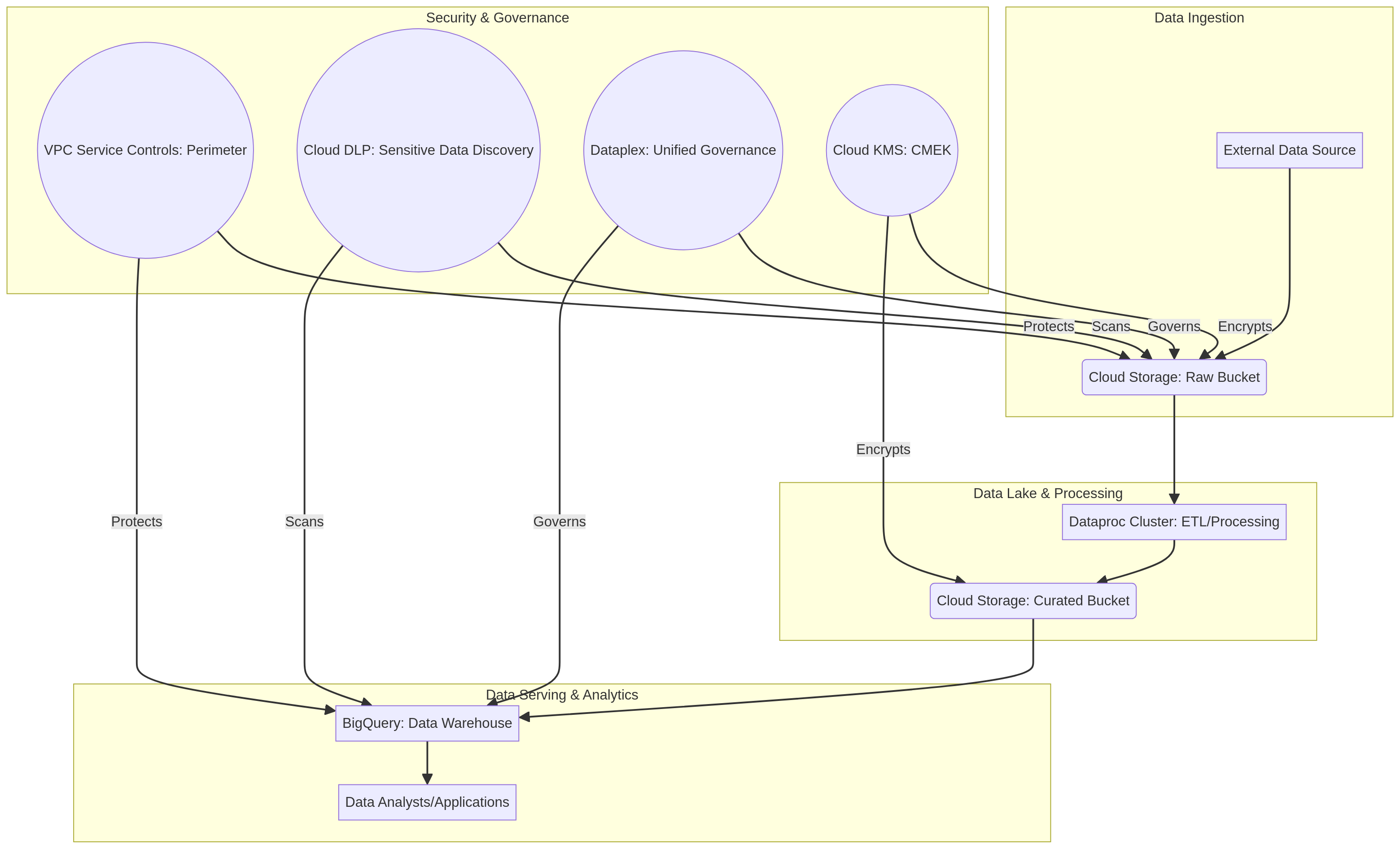
Architecture Diagram

PRJ-GCP-DATA-078 Architecture

Technology Stack

Cloud Storage
Dataproc
Spark
Hive
Data Lake

Complete Documentation

Prerequisites

Project Owner or Editor role
gcloud CLI configured
Terraform >= 1.5 (optional)
GCP project with billing enabled
Service Account with required APIs
1

Clone & Authenticate

Clone the repository and authenticate with gcloud using your service account key or application default credentials.

gcloud auth application-default login
2

Enable Required APIs

Enable all required GCP APIs for this project in your target project.

gcloud services enable compute.googleapis.com container.googleapis.com
3

Initialize Infrastructure

Run Terraform init and plan to preview the GCP resource changes before applying.

terraform init && terraform plan -out=tfplan
4

Deploy Resources

Apply the Terraform plan to provision all GCP resources in your target project.

terraform apply tfplan
5

Verify & Monitor

Verify the deployment in the GCP Console and check Cloud Monitoring for any errors.

gcloud logging read "severity>=ERROR" --limit 50

Deployment Guide

Step-by-step instructions to deploy this mission

Download Guide

Architecture Diagram

Visual representation of the system architecture

Download Architecture

Source Code

Complete source code and configuration files

View on GitHub

Video Tutorial

Watch the complete walkthrough video

Watch Now