Coming Soon AZURE Azure Solutions Architect

Azure Landing Zone

PRJ-AZURE-INFRA-066

Enterprise-scale foundation architecture

~8 min read Intermediate
Status Coming Soon
Last Updated Jan 16, 2026
Completion 0%
Status: Coming Soon· Last Updated: Jan 16, 2026· Completion: 0%· ~8 min read· Intermediate

Implementation Guide

Comprehensive step-by-step deployment guide

Download Implementation Guide

Estimated Monthly Cost

~$38/mo on minimal config
VMs $20VNet $0Monitor $8Storage $10
Business ContextLack of standardized cloud environment provisioning leads to inconsistent config…

The Problem

  • Lack of standardized cloud environment provisioning leads to inconsistent configurations and security vulnerabilities across Azure subscriptions.
  • Manual management of Azure resources results in operational overhead, human error, and slow deployment cycles for new projects.
  • Difficulty in enforcing enterprise-wide governance, compliance, and cost management policies across a growing Azure footprint.

The Solution

  • Implementation of Azure Management Groups to establish a hierarchical structure for consistent policy application and access management.
  • Automated deployment of Azure Subscriptions with predefined resource groups and network configurations using Azure Blueprints.
  • Centralized enforcement of security, compliance, and cost policies through Azure Policy across all managed resources.

Business Value

  • Reduces cloud environment provisioning time from weeks to hours, accelerating project delivery by 80%.
  • Achieves 99.9% compliance rate with internal security baselines and external regulatory requirements.
  • Decreases operational costs associated with manual configuration and auditing by 30% annually.
  • Enhances security posture by reducing misconfigurations by 75% and improving incident response times.

Risk Mitigation

  • Mitigates configuration drift by enforcing immutable infrastructure principles through Azure Blueprints.
  • Reduces unauthorized access and privilege escalation risks by implementing granular Role-Based Access Control (RBAC) via Management Groups.
  • Addresses compliance violations by continuously auditing resource configurations against defined Azure Policies.
  • Minimizes cost overruns by implementing budget controls and resource tagging policies.
GRC MappingISO 27001:2022(Information Security Management): Controls A.5.1, A.5.15, A.5.16,…

Compliance Frameworks

  • ISO 27001:2022 (Information Security Management): Controls A.5.1, A.5.15, A.5.16, A.8.1
  • NIST SP 800-53 Rev. 5 (Security and Privacy Controls): Controls AC-2, CM-2, SC-7, AU-2
  • SOC 2 Type 2 (Security, Availability, Confidentiality): Criteria CC1.2, CC6.1, CC6.2, CC7.1
  • CIS Azure Foundations Benchmark (Security Best Practices): Controls 1.1, 2.1, 3.1, 4.1

Security Controls Implemented

  • Access Control: Enforced via Azure Management Groups and RBAC to restrict administrative privileges.
  • Configuration Management: Standardized deployments using Azure Blueprints to prevent unauthorized changes.
  • Policy Enforcement: Automated compliance checks and remediation through Azure Policy for resource configurations.
  • Logging and Monitoring: Centralized activity logs and diagnostic settings integrated with Azure Monitor.
  • Network Segmentation: Defined network security groups (NSGs) and virtual networks within Azure Subscriptions.

Audit Evidence

  • Azure Policy compliance reports demonstrating adherence to organizational standards.
  • Azure Activity Logs detailing administrative actions and resource changes.
  • Azure Blueprint assignment reports confirming standardized environment deployments.
  • RBAC assignment reviews and access control matrices for Management Groups and Subscriptions.

Regulatory Alignment

  • GDPR (EU): Article 25 (Data Protection by Design and Default), Article 32 (Security of Processing)
  • HIPAA (US): 45 CFR Part 164.306 (Security Standards: General Rules), 45 CFR Part 164.312 (Technical Safeguards)
  • PCI DSS v4.0: Requirement 2 (Protect all systems against malware), Requirement 10 (Log and monitor all access to system components and cardholder data)
  • DORA (EU): Article 9 (ICT risk management framework), Article 10 (ICT security policies)

Video tutorial coming soon!

Subscribe to our YouTube channel to get notified when this tutorial is published.

Subscribe on YouTube

Architecture Diagram
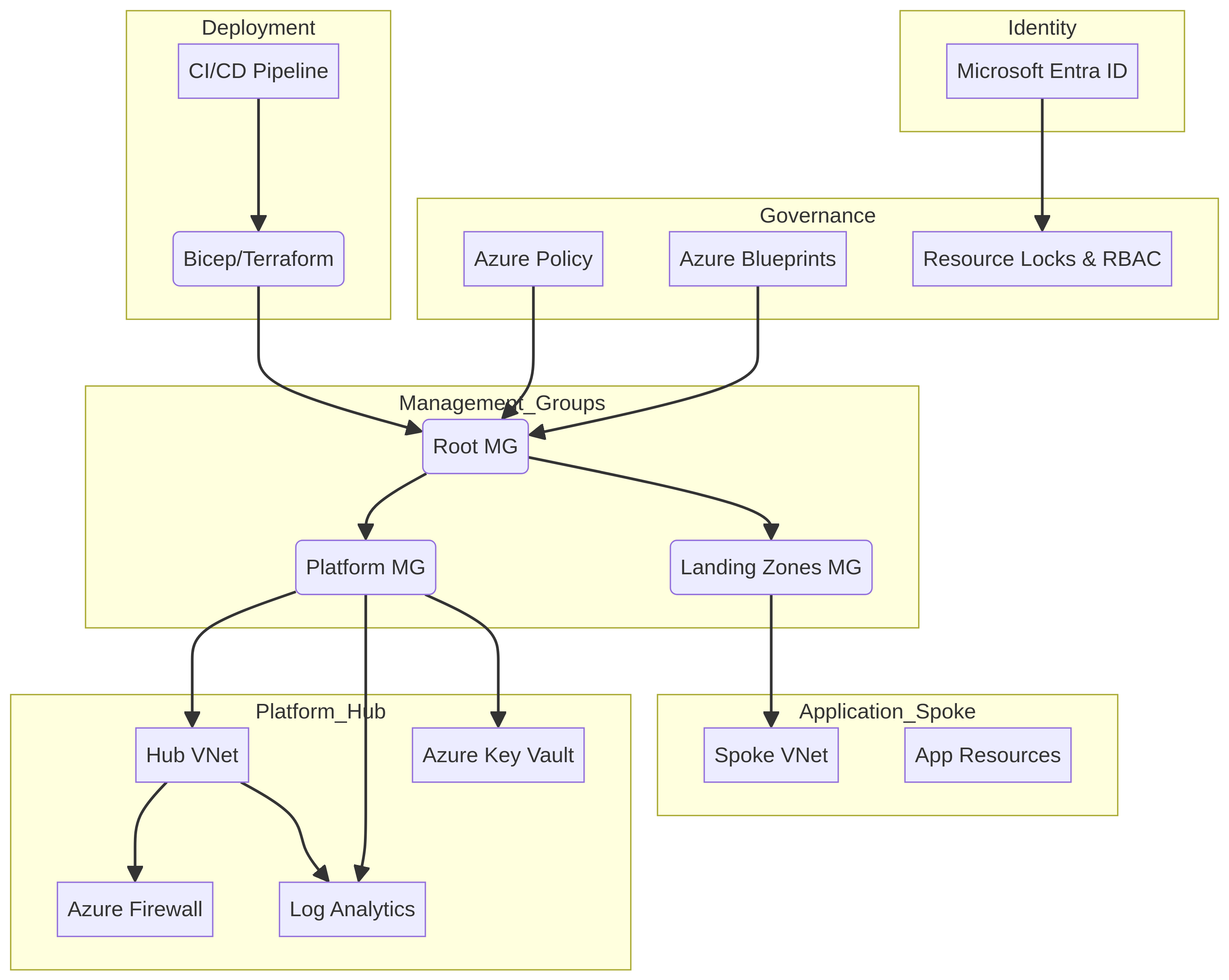
PRJ-AZURE-INFRA-066 Architecture

Technology Stack

Management Groups
Subscriptions
Policy
Blueprints

Complete Documentation

Prerequisites

Contributor or Owner role
Azure CLI 2.x configured
Terraform >= 1.5 (optional)
Active Azure subscription
Service Principal with RBAC
1

Clone & Authenticate

Clone the repository and authenticate with Azure CLI using your service principal or interactive login.

az login && az account set --subscription 
2

Review RBAC Assignments

Review the required role assignments and ensure your identity has the correct permissions in the target resource group.

az role assignment list --assignee 
3

Initialize Infrastructure

Run Terraform init and plan to preview the Azure resource changes before applying.

terraform init && terraform plan -out=tfplan
4

Deploy Resources

Apply the Terraform plan to provision all Azure resources in your target subscription.

terraform apply tfplan
5

Verify & Monitor

Verify the deployment in the Azure Portal and check Azure Monitor for any alerts or issues.

az monitor activity-log list --resource-group 

Deployment Guide

Step-by-step instructions to deploy this project

Download Guide

Architecture Diagram

Visual representation of the system architecture

Download Architecture

Source Code

Complete source code and configuration files

View on GitHub

Video Tutorial

Watch the complete walkthrough video

Watch Now