Coming Soon GCP GCP Cloud Architect

GKE Multi-Cluster Service Mesh

PRJ-GCP-K8S-085

Multi-cluster microservices architecture

~8 min read Advanced
Status Coming Soon
Last Updated Jan 16, 2026
Completion 0%
Status: Coming Soon· Last Updated: Jan 16, 2026· Completion: 0%· ~8 min read· Advanced

Implementation Guide

Comprehensive step-by-step deployment guide

Download Implementation Guide

Estimated Monthly Cost

~$40/mo on minimal config
GKE $22Cloud Run $8Storage $6Monitoring $4
Business ContextManaging complex distributed microservices across multiple geographically disper…

The Problem

  • Managing complex distributed microservices across multiple geographically dispersed GKE clusters leads to operational overhead and inconsistent configurations.
  • Lack of a unified control plane for traffic management, policy enforcement, and observability across disparate GKE clusters hinders application performance and troubleshooting.
  • Ensuring high availability, disaster recovery, and seamless service communication for critical applications in a multi-cluster environment is challenging without a robust service mesh.

The Solution

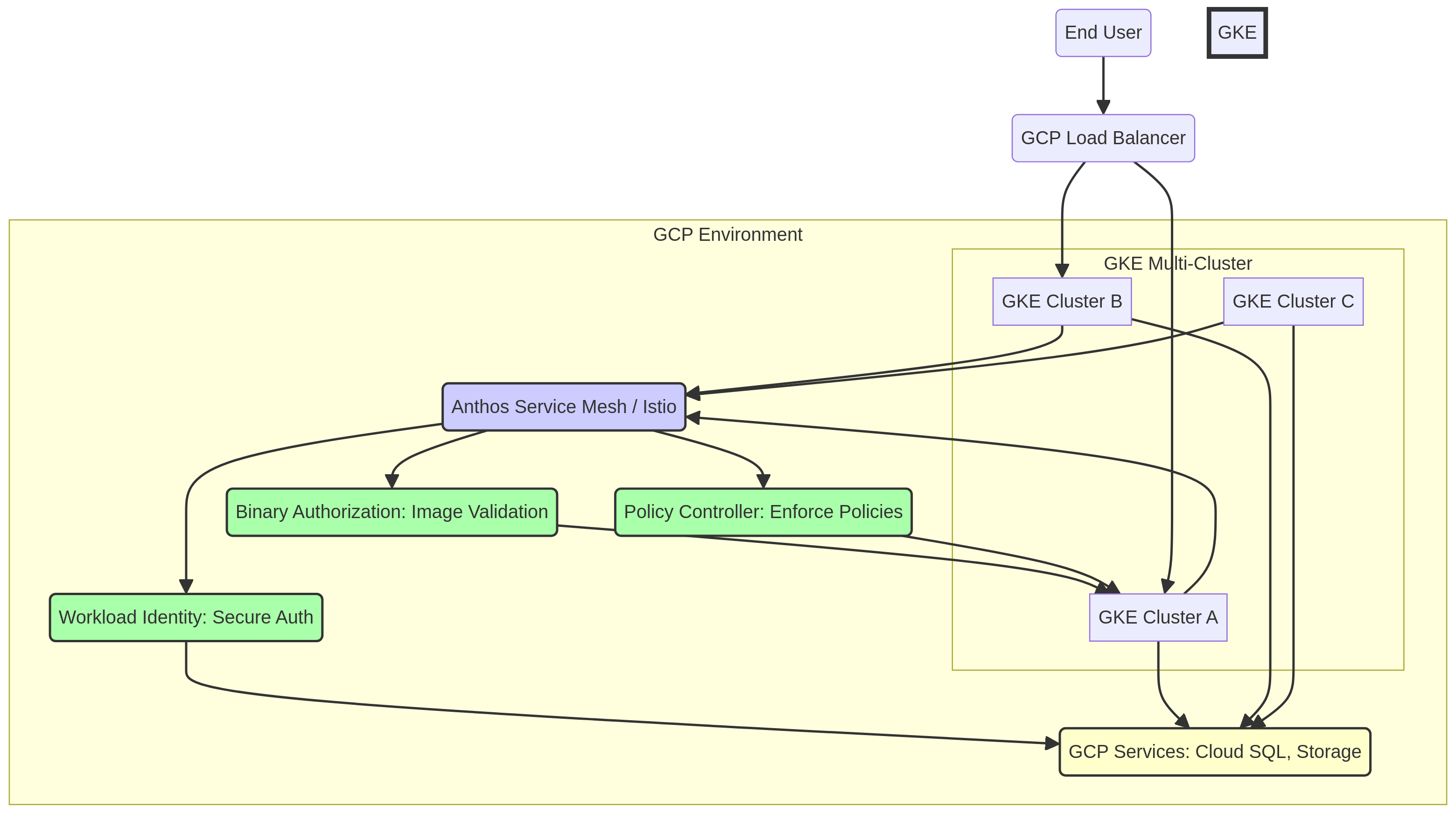
  • Implemented Anthos Service Mesh on GKE to provide a unified control plane for managing and observing microservices across multiple clusters.
  • Leveraged Istio's advanced traffic management capabilities (e.g., canary deployments, circuit breaking) and mutual TLS (mTLS) for secure service-to-service communication.
  • Utilized GCP Global External Load Balancing to distribute incoming traffic across GKE clusters, ensuring high availability and optimal routing.

Business Value

  • Reduces operational overhead for multi-cluster microservices management by 30% through centralized control and automation.
  • Achieves 99.99% uptime SLA for critical applications by enabling seamless failover and traffic shifting across GKE clusters.
  • Accelerates new service deployment time by 25% due to standardized service mesh patterns and automated policy enforcement.
  • Improves security posture by enforcing mTLS and fine-grained access control, reducing potential attack surfaces.

Risk Mitigation

  • Mitigates service outages due to single-cluster failures by enabling multi-cluster failover and global load balancing.
  • Reduces security vulnerabilities through automated mTLS and granular authorization policies enforced by Istio.
  • Addresses inconsistent application behavior across environments by standardizing service communication and policy enforcement.
  • Prevents unauthorized access and data exfiltration by encrypting all service-to-service traffic within the mesh.
GRC MappingNIST SP 800-53 (e.g., AC-3 Access Enforcement, SC-7 Boundary Protection)…

Compliance Frameworks

  • NIST SP 800-53 (e.g., AC-3 Access Enforcement, SC-7 Boundary Protection)
  • ISO 27001 (e.g., A.9 Access Control, A.13 Communications Security)
  • SOC 2 Type 2 (e.g., Common Criteria CC6.1 Logical Access, CC7.1 Network Security)
  • PCI DSS (e.g., Requirement 2.2 Configuration Standards, Requirement 4.1 Encrypt Transmission)

Security Controls Implemented

  • Access Control: Istio authorization policies enforce fine-grained access control between microservices based on service identity.
  • Network Segmentation: Anthos Service Mesh provides logical segmentation of services, controlling traffic flow between namespaces and clusters.
  • Encryption in Transit: Istio automatically enforces mutual TLS (mTLS) for all service-to-service communication within the mesh.
  • Configuration Management: GKE configuration management ensures consistent deployment and policy application across all clusters.
  • Logging and Monitoring: Anthos Service Mesh integrates with Cloud Monitoring and Cloud Logging for comprehensive observability and audit trails.

Audit Evidence

  • Istio policy configurations and manifests demonstrating access control rules and traffic management.
  • GKE audit logs and Cloud Audit Logs detailing administrative activities and service mesh events.
  • Network flow logs from GCP VPC and Load Balancing showing traffic patterns and security group enforcement.
  • Service mesh telemetry data and dashboards from Cloud Monitoring confirming mTLS enforcement and service health.

Regulatory Alignment

  • GDPR: Article 32 (Security of processing) - mTLS and access controls protect personal data in transit and at rest within services.
  • HIPAA: 164.312(e)(1) (Encryption/Decryption) - mTLS ensures encryption of ePHI exchanged between microservices.
  • CCPA: Section 1798.150 (Right to bring action) - robust access controls and logging provide accountability for personal information.
  • DORA: Article 9 (ICT security policies and procedures) - standardized service mesh policies and configurations ensure consistent security posture.

Video tutorial coming soon!

Subscribe to our YouTube channel to get notified when this tutorial is published.

Subscribe on YouTube

Architecture Diagram

PRJ-GCP-K8S-085 Architecture

Technology Stack

GKE
Anthos Service Mesh
Istio
Load Balancing

Complete Documentation

Prerequisites

Project Owner or Editor role
gcloud CLI configured
Terraform >= 1.5 (optional)
GCP project with billing enabled
Service Account with required APIs
1

Clone & Authenticate

Clone the repository and authenticate with gcloud using your service account key or application default credentials.

gcloud auth application-default login
2

Enable Required APIs

Enable all required GCP APIs for this project in your target project.

gcloud services enable compute.googleapis.com container.googleapis.com
3

Initialize Infrastructure

Run Terraform init and plan to preview the GCP resource changes before applying.

terraform init && terraform plan -out=tfplan
4

Deploy Resources

Apply the Terraform plan to provision all GCP resources in your target project.

terraform apply tfplan
5

Verify & Monitor

Verify the deployment in the GCP Console and check Cloud Monitoring for any errors.

gcloud logging read "severity>=ERROR" --limit 50

Deployment Guide

Step-by-step instructions to deploy this project

Download Guide

Architecture Diagram

Visual representation of the system architecture

Download Architecture

Source Code

Complete source code and configuration files

View on GitHub

Video Tutorial

Watch the complete walkthrough video

Watch Now